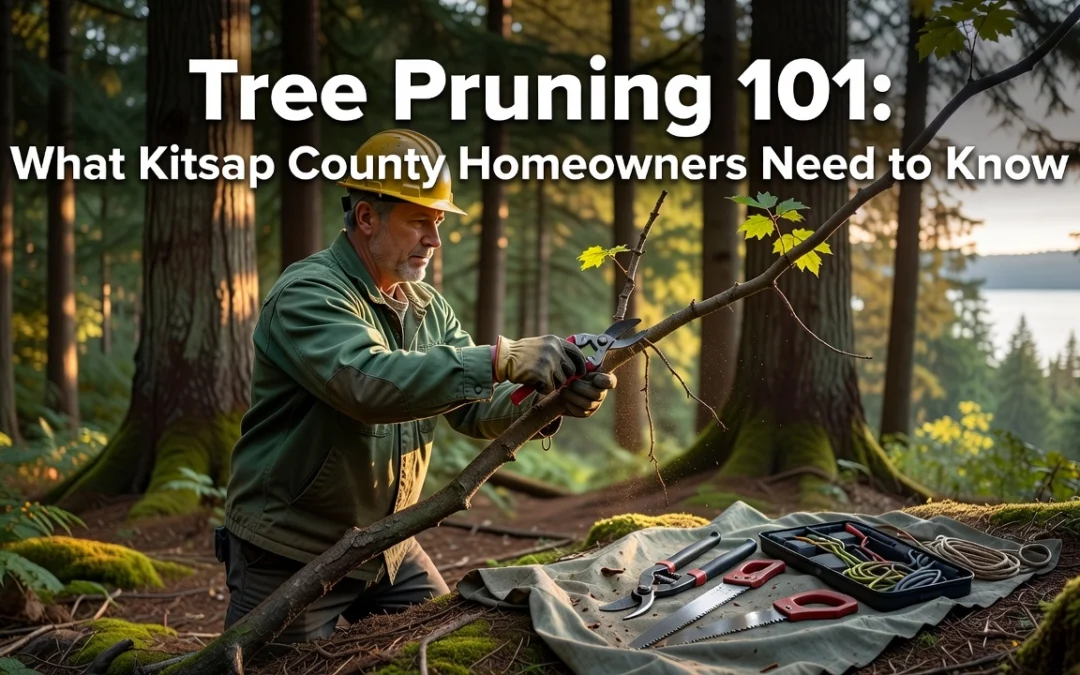
If you have trees on your property in Kitsap County, chances are you’ve stood in your yard at some point, looked up at a mess of tangled branches, and thought, “I should probably do something about that.” You’re not alone. Tree pruning is one of those home maintenance tasks that many people know they should do but aren’t quite sure how to approach.
Here’s the good news: tree pruning doesn’t have to be complicated or intimidating. With a little knowledge and the right approach, you can keep your trees healthy, looking great, and safe for your family and neighbors.
In this guide, we’re breaking it all down into simple, beginner-friendly tips designed specifically for Kitsap County homeowners. From the best time of year to prune your trees to the basic tools you’ll need, we’ve got you covered. We’ll also touch on some local considerations that make pruning in the Pacific Northwest a little unique. By the end, you’ll feel confident knowing exactly where to start. Let’s dig in!
Why Tree Pruning Matters More Than You Think
If you’ve ever looked at a tree in your yard and thought, “It’s fine, I’ll deal with it later,” you’re not alone. But here’s the thing: trees don’t stay “fine” on their own, and putting off pruning can turn a manageable task into a much bigger problem down the road.
Safety is the most immediate reason to keep up with pruning. Kitsap County gets its share of wet, windy winters, and those conditions are exactly when dead, weak, or overgrown limbs become dangerous. A heavy branch that’s been slowly dying for two seasons doesn’t need much encouragement to come down during a windstorm. It’s worth noting that storm-damaged trees are a recurring contracted need at the Kitsap County government level, which tells you something important: this isn’t a rare or isolated concern. It’s a consistent, documented problem in this area. Proactive pruning removes the hazard before the storm gives it a reason to become your problem.
Pruning is also one of the most effective things you can do for a tree’s long-term health. When diseased or dying wood is left on a tree, the infection doesn’t stay contained. It spreads. Regular pruning removes that compromised material early, improves airflow through the canopy (which reduces fungal pressure), and helps the tree direct its energy toward healthy growth. Trees that receive consistent care simply live longer and perform better, which matters whether you’re thinking about shade, privacy, or aesthetics.
The cost argument is hard to ignore. A routine pruning visit is a fraction of what you’d pay for emergency removal after a failure. Emergency jobs involve hazard conditions, specialized equipment, and urgency pricing that routine maintenance doesn’t. Skipping the $300 pruning call today can easily become a $3,000 emergency removal call next year.
Well-maintained trees also add real, measurable value to your property. According to research on how tree trimming increases property value, proper tree maintenance can deliver substantial financial returns over time. Unlike most landscaping investments that fade or require replacement, trees grow and compound in value when properly cared for. They’re one of the few outdoor investments that actually appreciates.
It’s no surprise, then, that 38% of homeowners actively seeking tree services are looking specifically for trimming and pruning, making it the second most requested tree service behind removal. If you’ve been on the fence about scheduling a pruning visit, consider this your sign to stop waiting.
Types of Tree Pruning Explained in Plain Language
Not all pruning is the same, and knowing the difference can help you have a much more productive conversation with your arborist. Here’s a plain-language breakdown of the six most common types of tree pruning, what each one does, and when you might need it.
1. Crown Cleaning and Deadwood Removal
This is the starting point for almost every tree that hasn’t been touched in a few years, and it’s exactly what it sounds like: removing branches that are dead, dying, diseased, or broken from the canopy. Crown cleaning is the most universally recommended first step in any pruning job, and here’s why that matters practically. Once the deadwood comes out, a tree often looks significantly better and may need less additional work than you initially expected. Think of it like clearing clutter before you rearrange furniture; you get a much clearer picture of what you’re actually working with.
Beyond looks, deadwood removal reduces the risk of branch failures, which is a real safety concern if branches hang over a driveway, roof, or play area. It also has a diagnostic value: a qualified arborist can monitor whether new deadwood reappears after a cleaning, which helps track a tree’s overall health over time. If you only do one thing for a neglected tree, crown cleaning is the right place to start.
2. Crown Thinning
Crown thinning means selectively removing live branches from a dense canopy to improve how light and air move through the tree, without changing its overall size or shape. If your tree is shading out the lawn below or your garden isn’t getting enough sun, this is likely the service you need. It’s also one of the better ways to reduce storm damage risk, because a thinned canopy lets wind pass through rather than catching it like a sail.
Professional standards recommend removing no more than 15 to 25 percent of the living canopy in a single session. That guideline exists for good reason: over-thinning stresses the tree and can trigger unhealthy regrowth. The goal is balance, not a dramatic transformation. Crown thinning and crown cleaning are often done together in the same visit, since both focus on improving canopy health from within.
3. Crown Raising
Crown raising is about lifting the lower edge of the canopy to create clearance underneath it. This is a common need for homeowners with mature trees close to the house, over a driveway, along a walkway, or near a fence line. If you’ve had to duck under branches to mow the lawn or pull into the garage, crown raising is probably what you’re looking for.
There’s an important limit to keep in mind here: after raising, the live crown should still make up at least two-thirds of the tree’s total height. Going beyond that, sometimes called “limbing up,” creates an unnatural shape that’s structurally weaker and more vulnerable to storm breakage. The general clearance benchmarks used by municipalities are around 8 feet over sidewalks and 14 feet over roads, which gives you a useful reference point. Crown raising is also best done while a tree is still young, since smaller pruning wounds heal faster and with less stress to the tree.
4. Crown Reduction (and Why It Is Not Topping)
Crown reduction reduces the overall height or spread of a tree by cutting branches back to appropriate lateral branches, ones large enough to take over as the new leader. The tree gets smaller while keeping a natural, proportional shape. This is the right approach when a tree has outgrown its space or when branches are encroaching on a structure.
What crown reduction is not is topping. Topping means cutting branches to random stubs with no regard for where the cut lands. According to the ISA’s research on pruning terminology, “topping” and “heading” are frequently misapplied terms that create serious confusion between arborists and homeowners. In practice, topping triggers a burst of weak, poorly attached regrowth, makes the tree structurally more dangerous than before, and often leads to long-term decline. Every credible arboriculture organization condemns the practice. If someone quotes you a job that involves cutting the top off your tree without referencing lateral branch junctions, that’s a red flag worth taking seriously.
5. Structural or Formative Pruning
Structural pruning is done on younger trees to guide how they grow before problems develop. The goal is to encourage a single dominant leader, reduce competing limbs, and manage branch spacing so the tree builds a strong, stable framework from the ground up. Think of it as the difference between correcting posture early versus dealing with chronic back problems later.
This type of pruning is sometimes described as the only pruning done entirely for the tree’s benefit, and that framing is worth taking seriously. A tree that develops good structure early is far less likely to need costly corrective work, emergency removal, or hazard mitigation down the road. Structural pruning typically needs to be repeated every two to three years until the tree establishes its form, making it a genuine long-term investment rather than a one-time expense. For newer plantings or trees added as part of a landscaping project, getting started early pays dividends for decades.
6. Vista Pruning
Vista pruning is a more targeted technique: instead of thinning or reducing the entire canopy, an arborist selectively removes specific branches to open up a particular sightline through or past the tree. The rest of the tree stays intact. For more detail on how tree pruning methods like this work in practice, it helps to understand that precision matters more here than volume of branches removed.
For Kitsap County homeowners, this service is especially relevant. Water views are a significant part of what makes properties here valuable, and mature trees that have filled in over the years can quietly eat away at those views without homeowners realizing a targeted pruning solution even exists. Vista pruning threads the needle: you keep the tree, protect the property value it adds, and get your view back. It takes an experienced eye to do it well, which is exactly why this kind of work benefits from working with someone who knows both trees and the local landscape.
When to Prune Trees in the Pacific Northwest
Timing is everything when it comes to pruning, and this is especially true in the Pacific Northwest where the climate adds a few extra wrinkles to the standard advice you might find online.
The Best Time for Most Trees: Late Winter to Early Spring
For the majority of trees in Kitsap County and the surrounding region, the sweet spot for pruning falls between late February and early April. During this window, trees are still dormant but just starting to wake up, which means two important things: wounds close faster because the tree is about to push new growth, and disease pressure is still relatively low before the warmth of spring kicks fungal and insect activity into gear. According to research on best practices for trimming trees, trees pruned during late winter dormancy close wounds approximately 85% faster than cuts made during the growing season, and experience about 40% less stress overall. There’s a reason PNW arborists sometimes joke that “ski season is pruning season.” Dormant trees also have no leaves to block your view, which makes it much easier to spot weak branch attachments, crossing limbs, and structural problems before they become hazards.
One small caveat worth knowing: avoid pruning during hard freezes. When temperatures drop sharply, wood becomes brittle and freshly cut tissue can freeze before it has a chance to begin closing. A few days of patience can make a real difference.
Summer Pruning: Fine for Light Work, Not Heavy Cuts
Summer pruning is not off the table entirely. Light shaping, size control, and deadwood removal are all reasonable tasks during the growing season. The active growth period means trees can recover from minor cuts fairly quickly. The key is to avoid heavy structural cuts during peak heat. When a tree is already managing water stress on a hot July afternoon, removing large limbs forces it to redirect significant energy reserves toward wound response, which can slow healing and leave it vulnerable. Keep summer work light and targeted.
Why Fall Is the Worst Time to Prune in the PNW
If there’s one season to avoid for elective pruning, it’s fall. As trees head into dormancy, their ability to close wounds slows dramatically. Combine that with the Pacific Northwest’s notoriously damp autumn conditions, and you have a situation where fresh cut sites stay moist for extended periods, creating ideal conditions for fungal spores to take hold. This is a region-specific concern that matters more here than in drier climates across the country.
Species-Specific Timing for Common PNW Trees
Not every tree follows the same calendar, and a few species common to Western Washington require extra attention to timing.
Douglas fir should be pruned in late winter during dormancy. Pruning during the growing season opens the tree up to bark beetles and fungal pathogens, including needle blight and root rot, both of which thrive in the wet soils common to this region. Winter pruning sidesteps the period when beetles are most actively spreading disease from tree to tree.
Big-leaf maple is best pruned in late winter before leaf-out, though the timing requires some care. As PNW arborists note, big-leaf maples can push sap through a wound aggressively from November through March, which adds stress if cuts are too large. Late January through early March tends to be the general sweet spot. That said, there is a legitimate debate among professionals: some arborists prefer drier summer conditions for maples because wound closure can happen faster in warm weather and fungal risk drops when conditions are less soggy. If you have a big-leaf maple and are unsure, consulting a certified arborist is the safest approach.
Pacific madrone is a different story altogether. If you have one of these beautiful native trees on your property, the general advice from local experts is to prune as infrequently as possible. When pruning is truly necessary, dry summer months are strongly preferred because the reduced moisture dramatically lowers the risk of fungal infection at the wound site. Madrones are remarkably resilient in the wild without intervention, so less is genuinely more here.
Ornamental cherries and other flowering trees such as magnolias and dogwoods should be pruned immediately after they finish blooming. These trees set next year’s flower buds on the previous season’s wood, so pruning at the wrong time means cutting off an entire year’s worth of blooms before they ever get the chance to open.
One final note that applies across all of these guidelines: seasonal timing rules are for planned, structural pruning. If a branch is dead, damaged, or poses a safety risk, it should come down right away regardless of the time of year.
DIY vs. Hiring a Pro: How to Know the Difference
One of the most common questions homeowners ask is simple: can I do this myself, or do I need to call someone? The honest answer is that it depends on a few specific factors, and getting it right matters more than most people realize.
When DIY Makes Sense
There are situations where handling light pruning yourself is completely reasonable. If the branches you’re working with are under 2 inches in diameter, the work is at ground level or reachable from a standard household ladder, and the tree is otherwise healthy, you’re likely in safe DIY territory. Think of it as routine maintenance: removing a few small crossing branches, trimming back a young shrub-like tree, or cleaning up minor deadwood after a windstorm. For jobs like these, a good pair of bypass pruners or a small hand saw will usually get the work done without any special expertise.
The Power Line Rule: No Exceptions
If any part of the tree is growing near or into power lines, stop. This is not a judgment call. It does not matter how close the branch is, how small it looks, or how confident you feel with a pole saw. Working near energized lines is one of the most dangerous situations in tree care, and it is not something a homeowner should attempt under any circumstances. Professional tree crews train specifically for this type of work and coordinate with utilities when needed. The risk simply is not worth it.
Signs You Need a Professional
Beyond the power line rule, several other situations call for a certified arborist. Large or heavy limbs create serious drop hazards that require rigging equipment and technical knowledge to remove safely. If your tree shows signs of disease, fungal growth, soft spots in the bark, or unusual lean, a professional needs to assess the situation before any cutting happens. Structural problems in a tree can turn a routine pruning job into a major hazard if the wrong branch is removed at the wrong time. And if you are genuinely unsure what type of pruning the tree needs, that uncertainty alone is a reason to call.
The Hidden Cost of Getting It Wrong
Improper pruning techniques cause real, lasting damage. Flush cuts (removing the branch collar), topping (cutting back the main leader), and bark stripping are among the most common DIY mistakes, and they do not just look bad. They create open wounds that invite fungal infection, weaken the tree’s structural integrity, and can lead to decay that spreads over years. One bad cut today can mean a much more expensive removal five years from now.
According to industry data, roughly 70% of homeowners have never hired a tree service before, which means most people making these calls are doing so without much of a reference point. A free consultation with a certified arborist costs nothing and can give you a clear picture of what your tree actually needs. When in doubt, a quick estimate from an experienced professional is always the smarter move.
What Affects the Cost of Tree Pruning
Cost is one of the first things most homeowners think about when they start looking into tree services, and that makes complete sense. According to industry research, 26% of homeowners say cost is their number one factor when choosing a tree care provider. But understanding what drives the price can actually help you make smarter decisions and spend less in the long run.
Here are the main factors that influence what you’ll pay for tree pruning:
1. Tree Size and Height
This is the biggest one. Taller trees require more time, more specialized equipment, and a higher level of technical skill to prune safely. A small ornamental tree under 30 feet might run anywhere from $150 to $400, while a large tree over 60 feet can push $1,500 or more depending on the job. Bucket trucks and rigging equipment are sometimes required for taller work, and that equipment costs money to operate.
2. Proximity to Structures, Utilities, and Hazards
A tree growing close to your house, a fence, or a power line takes considerably more care to prune. Crews have to position equipment carefully, work more slowly, and sometimes bring in additional tools to avoid causing damage. That extra time and precision is reflected in the final quote.
3. Type of Pruning Required
Light maintenance pruning on a healthy young tree is a very different job from a full crown reduction on a large, mature tree near your roof. As you learned in the earlier section of this guide, pruning comes in several forms, and more intensive work naturally costs more. Scope matters.
4. Tree Health and Structural Complexity
Diseased, rotting, or structurally compromised trees require slower, more deliberate work. Crews need to anticipate how a weakened branch might behave when cut, which takes more skill and more time. Dense hardwood species like oak also take longer to work through than softer trees.
5. Site Access
A tree tucked behind a locked gate, on a steep slope, or in a tight corner near your foundation is simply harder to get to. That affects how long the job takes and what equipment can be used.
6. The Smarter Long-Term Strategy
The most cost-effective approach is consistent, routine maintenance rather than waiting until a tree becomes a serious problem. Deferred pruning almost always leads to more expensive interventions later. For a useful breakdown of how these pricing factors come together in practice, this 2026 tree trimming cost guide is worth a read.
7. Insurance and Credentials
Hiring an uninsured or uncertified crew might look like a bargain upfront, but it can expose you to real financial liability if property is damaged or someone gets hurt on your property. Working with a fully insured, experienced team like Lefler Tree Service is a form of protection, not just a preference. It is worth noting that Kitsap County itself requires ISA-certified arborists for contracted tree work, which speaks to why credentials genuinely matter.
When you call for an estimate, a reputable crew will always assess the job in person before quoting. Any flat rate given without seeing the tree first should prompt a few follow-up questions.
What to Look for When Hiring a Tree Pruning Service
Once you’ve decided to bring in a professional, the next step is figuring out who to actually hire. Not all tree services are created equal, and knowing what to look for upfront can save you a lot of headaches down the road. Here are the key things to check before you sign anything.
1. Look for ISA Certification
ISA stands for International Society of Arboriculture, and their Certified Arborist credential is the industry standard for tree health expertise. To earn it, a candidate needs at least three years of hands-on arboriculture experience and must pass a comprehensive exam developed by leading experts in the field. It’s not a quick online certificate; it’s a real professional credential. What makes it especially relevant locally is that Kitsap County requires ISA-certified arborists for contracted tree evaluations, which tells you something about how seriously the credential is taken in this area. You can verify whether an arborist holds current certification through the ISA’s public lookup tool on their website. If a company can’t point you to a certified arborist on their team, that’s worth noting.
2. Verify Insurance Before Anyone Steps on Your Property
This one is non-negotiable. You need to confirm two types of coverage: general liability insurance and workers’ compensation. Liability covers damage to your property if something goes wrong during the job. Workers’ comp covers injuries to the crew while they’re working on your land. Here’s what catches a lot of homeowners off guard: if an uninsured worker gets hurt on your property, you could be held financially responsible. Your homeowner’s policy typically won’t cover it. Only 13% of homeowners list insurance and certifications as a top selection factor, but the reality is that every single homeowner is at risk when this piece is skipped. Ask for the certificate of insurance directly, and make sure it’s current.
3. Prioritize Local, Long-Term Experience
A company that has been working in Kitsap County for decades brings something a newer operation simply can’t offer: deep familiarity with the specific trees, soil conditions, and seasonal weather patterns of the Pacific Northwest. Knowing how a big-leaf maple responds to winter pruning, or how our wet seasons affect wound closure, is the kind of practical knowledge that only comes from years of local work. Longevity in a market is also a trust signal on its own; companies that cut corners don’t tend to last.
4. Expect a Free, Written Estimate
Any reputable tree service should be willing to assess your trees and give you a clear, written estimate before you commit to anything. Free estimates are standard practice in this market. Getting it in writing protects you from scope creep and pricing surprises. If a company pushes for payment upfront or only offers a verbal quote, treat that as a red flag and keep looking.
Why Kitsap County Homeowners Trust Lefler Tree Service
If you’ve made it this far in this guide, you already know what good tree pruning looks like. The next question is who you want doing it on your property. Here’s why so many Kitsap County homeowners have come back to Lefler Tree Service year after year.
35+ Years of Local Experience
Lefler Tree Service has been serving Kitsap County since 1988, which means the team has been pruning trees here longer than many local companies have been in business. That kind of tenure isn’t just a number. It means Lefler has worked through decades of Pacific Northwest weather, seen how local trees respond to different pruning approaches, and built a reputation entirely on word-of-mouth and repeat business from real neighbors.
Deep Knowledge of Pacific Northwest Trees and Climate
Pruning a Douglas fir, a big-leaf maple, or a Western red cedar correctly takes more than general tree knowledge. It takes familiarity with how these species behave in a maritime climate, when they’re most vulnerable to fungal disease, and how Kitsap’s wet winters affect wound closure and regrowth. That regional knowledge directly shapes when and how Lefler’s team makes pruning decisions on your property.
Fully Insured, Safety-First on Every Job
Whether it’s a routine canopy thinning or a complex crown reduction near your roofline, every job is handled with full insurance coverage and a genuine commitment to safety. That protects you, your property, and the crew doing the work.
Free Estimates, No Pressure
Lefler offers free estimates that are straightforward assessments of what your trees actually need. You get honest advice, not an upsell.
A Local Family Business, Not a Franchise
When you call Lefler, you’re talking to people who live and work in Kitsap County. They’re not a regional franchise or a national chain dispatching crews from three counties away. That local accountability makes a real difference in how the work gets done and how the company stands behind it.
The Bottom Line on Tree Pruning
Tree pruning is one of the smartest, most practical things you can do for your property, and that’s especially true here in Kitsap County where wet winters, heavy winds, and saturated soils put real stress on trees every single year. Regular pruning keeps your trees structurally sound, reduces the risk of storm damage, and prevents the kind of slow decline that turns a healthy tree into a hazard. According to a homeowner’s guide to healthy trees, when maintenance gets skipped, trees can develop serious structural problems and become a liability rather than an asset.
The three things that make the biggest difference are knowing which type of pruning your tree actually needs, choosing the right time of year to do it, and recognizing when the job is beyond DIY territory. Get those three things right, and you’re ahead of most homeowners.
If your trees haven’t been touched in a few years, or if you’re noticing dead wood, a crowded canopy, or branches creeping toward your roofline or utility lines, that’s your sign to get a professional set of eyes on them sooner rather than later.
Lefler Tree Service offers free estimates with absolutely no obligation. Call us or fill out the contact form and we’ll come take an honest look at your trees and tell you exactly what they need.
Conclusion
Tree pruning doesn’t have to feel overwhelming. As a Kitsap County homeowner, keeping a few key principles in mind will set you up for success: prune at the right time of year, use the proper tools, follow safe cutting techniques, and always account for the unique growing conditions of the Pacific Northwest.
Healthy, well-maintained trees add beauty, safety, and real value to your property. A little effort now can prevent costly problems down the road and keep your landscape thriving for years to come.
Ready to get started? Walk your yard today and take note of any branches that need attention. If the job feels too big or involves large, hazardous limbs, don’t hesitate to call a certified local arborist. Your trees are worth the investment, and so is your peace of mind.