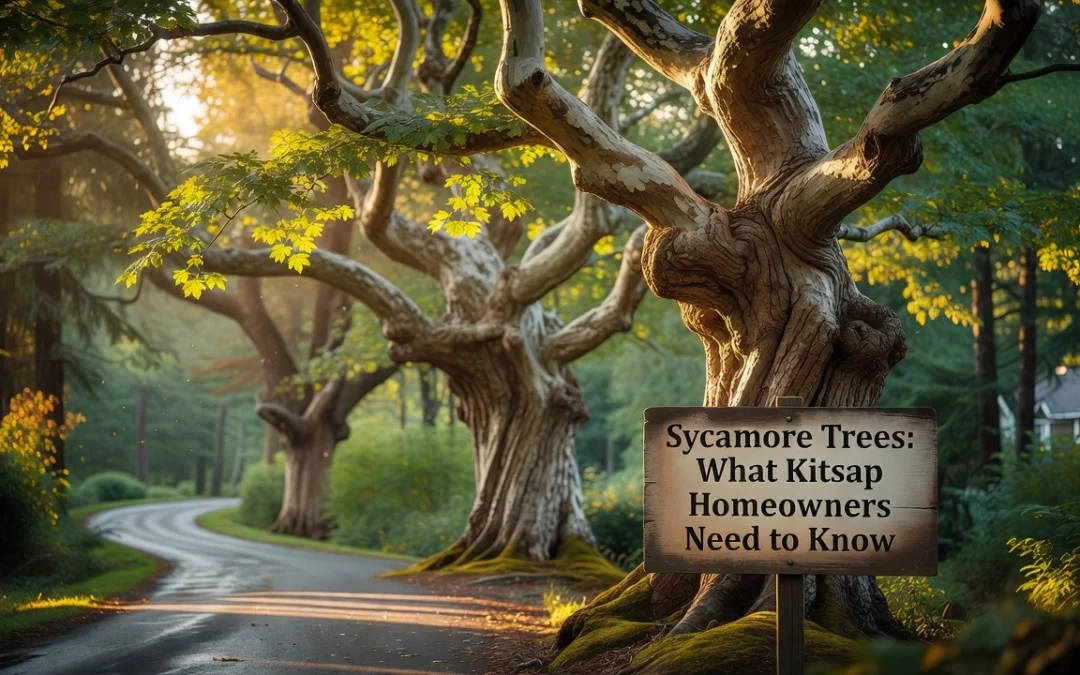
If you have a massive, eye-catching tree in your yard with peeling bark that reveals patches of white, gray, and green underneath, chances are you are living alongside a sycamore tree. These giants are a familiar sight across Kitsap County, and while they are undeniably beautiful, they come with their own unique set of quirks that every homeowner should know about.
Whether you just moved into a home with one of these towering trees on the property or you have been scratching your head over that unusual bark for years, this guide is for you. Sycamore trees can be wonderful additions to a landscape, offering plenty of shade and a striking appearance. But they also require some attention and understanding to keep them healthy and your property safe.
In this post, we are breaking down everything Kitsap homeowners need to know about sycamore trees. From identifying common issues to understanding their growth habits, you will walk away with a much clearer picture of what it takes to care for these impressive trees.
What Is a Sycamore Tree? Species Found in Western Washington
If you have a large, fast-growing tree in your Kitsap County yard with peeling bark and massive leaves, there’s a good chance you’re looking at a sycamore, or more precisely, its close relative the London plane tree. Knowing which one you have actually matters more than you might think.
The two species most relevant to western Washington are the American sycamore (Platanus occidentalis) and the London plane tree (Platanus x acerifolia). The American sycamore is native to the eastern United States and is rarely found in western Washington outside of introduced plantings. According to the USDA Forest Service, its natural range does not extend into the Pacific Northwest. The London plane tree, a hybrid of the American sycamore and the Oriental plane tree, is the species you are far more likely to encounter on streets, parks, and residential properties throughout Puget Sound and Kitsap County. It was widely adopted as an ornamental planting because of its stronger tolerance for wet coastal conditions and urban stress.
Both species share the same striking visual features that make sycamores so recognizable. The bark peels away in irregular patches, revealing a mottled mix of white, tan, and gray underneath, almost like camouflage. The leaves are large and palmately lobed, similar in shape to a maple leaf but significantly bigger. At full maturity, these trees can easily exceed 70 feet in height with a broad, irregular canopy that commands serious space in any yard.
Knowing which species you have is not just trivia. Pruning timing, susceptibility to diseases like sycamore anthracnose, and root behavior can differ between the two. Treating a London plane tree as if it were a pure American sycamore could mean applying the wrong care approach at the wrong time of year. When in doubt, having a qualified arborist take a look is always the smarter first step.
Sycamore Tree Size, Canopy Spread, and What to Expect Over Time
Sycamores are not small trees, and that point deserves some real emphasis before one gets planted in a tight yard. Mature specimens commonly reach 75 to 100 feet tall with canopy spreads pushing 50 to 70 feet wide. To put that in perspective, a full-grown sycamore can shade an entire residential lot from a single trunk. For Kitsap homeowners evaluating placement near a garage, fence line, or foundation, these numbers matter a great deal before the first shovel goes in the ground.
The growth rate makes early planning even more critical. Young sycamores can add 2 to 3 feet of height per year under good conditions. According to American Sycamore tree facts from PlantingTree, these trees grow rapidly and can transform a sunny yard into full shade within a single decade. A tree planted near a driveway today can become a structural concern well before your next roof replacement.
That dense canopy is also a storm liability. Kitsap County winters bring sustained wind events and heavy rain, and a broad sycamore canopy acts like a sail in those conditions. Limb drop becomes a real risk as the tree ages, especially if canopy thinning is neglected. Proactive pruning is not just a cosmetic choice here; it is genuinely protective.
Finally, sycamores can live well beyond 250 years. The decisions you make now about pruning schedules, disease management, and placement will shape your property for generations. That kind of long-term consequence is worth a conversation with an experienced arborist sooner rather than later.
How and When to Prune a Sycamore Tree
Timing matters more than most homeowners realize when it comes to sycamore pruning. The best window is late winter to early spring, right before bud break, when the tree is still dormant. Pruning during this period reduces stress on the tree, gives wounds a chance to begin compartmentalizing before active growth kicks in, and, critically for sycamores, minimizes the tree’s exposure to the fungal spores responsible for anthracnose. Sycamores are particularly susceptible to this fungal disease, and the wet Pacific Northwest springs we get on the Kitsap Peninsula create ideal conditions for spore spread. Getting cuts made before that wet spring weather arrives gives your tree a real advantage.
Follow ANSI A300 Standards (And Make Sure Your Crew Does Too)
When hiring a tree service for sycamore pruning, it’s worth asking whether they work to ANSI A300 pruning standards, which are the nationally recognized performance benchmark for professional tree care. These standards cover structural pruning, crown reduction, and canopy thinning, and they exist precisely because large-canopy trees like sycamores are easy to over-prune if a crew isn’t following a clear set of guidelines. A team trained to A300 knows how to write a proper pruning prescription before a single cut is made.
Crown Thinning Is Especially Important Here
For Kitsap homeowners, crown thinning deserves specific attention. Reducing interior canopy density lowers the tree’s wind resistance, which translates directly into a lower risk of major limb failure during the heavy fall and winter storms this region regularly sees. Think of a dense sycamore canopy like a sail; the more surface area it catches, the more force the tree has to absorb. Selective thinning takes that wind load down significantly.
Pruning Mistakes That Cause Real Damage
A few common DIY mistakes are worth calling out directly. Topping a sycamore is one of the worst things you can do; it triggers rapid, weak regrowth and creates large open wounds that invite disease. Removing more than 25% of the live canopy in a single season is another frequent error that stresses the tree and can take years to recover from. Cutting flush against the trunk, rather than just outside the branch collar, interferes with the tree’s natural wound-closure process and introduces decay risk.
Why Professional Assessment Matters Before Any Cut
[ISA-certified arborists](https://treecareindustryassociation.org/tree-pruning-to-ansi-standards/) are trained to spot structural issues that most homeowners simply won’t notice, including included bark, co-dominant stems, and internal decay. On a mature sycamore, these defects directly affect where cuts should and shouldn’t be made. Missing them isn’t just a pruning error; it can compromise the structural integrity of the entire tree. The team at Lefler Tree Service brings over 35 years of Kitsap County experience to every job, which means they’ve seen these issues across hundreds of local trees and know exactly what to look for before the first cut is made.
Sycamore Anthracnose and Disease Risks in the Pacific Northwest
If you’ve ever watched your sycamore drop leaves in late spring and assumed it was just adjusting to the season, there’s a good chance something else was going on. Sycamore anthracnose is the most common and damaging disease affecting these trees in western Washington, and Kitsap County’s cool, wet springs create almost ideal conditions for the fungus Apiognomonia veneta to spread. When temperatures stay mild and moisture lingers through April and May, spore activity ramps up fast. Outbreak years in our region are not rare; they’re a predictable pattern that sycamore owners should plan for.
Recognizing the Symptoms
The early warning signs show up in spring as brown, irregular blotches along the leaf veins, sometimes mistaken for frost damage or normal die-off. From there, things can escalate quickly. Premature defoliation is common, with some trees dropping most of their leaves in spring before releafing again in summer. You may also see twig dieback on current-season growth, and in severe or repeated infection years, cankers can develop on larger branches. The “shepherd’s crook” curl of dying young shoots is a particularly telling sign. Many homeowners chalk the leaf drop up to seasonal change and wait it out, which unfortunately gives the disease more time to take hold.
Why Early Action Matters
Repeated annual infections gradually wear down a sycamore’s structural integrity and its ability to store energy. A weakened tree becomes an easier target for secondary fungal problems, borer activity, and physical storm damage, which is a real concern given Kitsap County’s wind exposure. Addressing anthracnose early is significantly less expensive than dealing with advanced decline or emergency removal down the road.
What You Can Do
A few cultural practices go a long way. Rake and remove fallen leaves each autumn, since infected leaf litter is the primary source of overwintering spores. Avoid watering overhead, as wet foliage accelerates spore spread. Proper canopy thinning by a qualified arborist also improves airflow through the crown, reducing the moisture buildup the fungus relies on.
For higher-risk years, fungicide applications timed at bud swell and early leaf emergence are the most effective professional intervention. Certified arborists, including the team at Lefler Tree Service, increasingly offer spring fungicide programs tailored to sycamores and London plane trees as part of broader plant health care services.
Sycamore Root Systems: Risks to Foundations, Pipes, and Driveways
The root system is where sycamore trees cause their most expensive, least visible damage. These trees produce aggressive, wide-spreading roots that routinely extend 2 to 3 times beyond the canopy’s edge. That means a sycamore with a 30-foot crown spread could have roots pushing 60 to 90 feet outward in every direction. What looks like a tree planted at a safe distance from your house today can quietly become a major structural problem within a decade or two.
Surface roots are one of the first visible warning signs. As sycamores mature, roots near the soil surface lift sidewalks, crack driveway slabs, and create uneven ground that becomes a tripping hazard. This problem is more pronounced in Kitsap County specifically because of the region’s clay-heavy soils. Clay limits downward root penetration, so roots spread laterally and stay shallow, closer to the surface where your hardscaping lives. What drains well in other environments doesn’t behave the same way here, and that changes the risk picture considerably for local homeowners.
Underground, water-seeking roots are a quieter but potentially costlier issue. Sycamore roots will follow moisture wherever it leads, including into aging sewer lines and irrigation systems. Older Kitsap County neighborhoods, many of which still have clay or older PVC pipes with worn joints or hairline cracks, are especially vulnerable. A root doesn’t break a pipe all at once; it finds a small opening, grows into it, and gradually causes blockages or collapse. Arborists and homeowners alike note this pattern in discussions about sycamores planted near older homes.
Root barriers can work well as a preventive measure when a sycamore is young and the root system is still contained. Once a mature tree is already established near your foundation or utility lines, barriers offer very little practical benefit. At that stage, the more honest conversation is about professional evaluation and whether removal makes more financial sense than ongoing risk.
If you have a sycamore within 20 feet of a structure, driveway, or known utility corridor, getting a certified arborist out to assess the situation before damage occurs is the smartest move you can make. The cost of an evaluation is a fraction of what foundation repairs or pipe replacement can run. At Lefler Tree Service, we’ve been helping Kitsap County homeowners navigate exactly these situations since 1988, and early intervention almost always leads to better outcomes than waiting for a problem to become impossible to ignore.
How Kitsap’s Coastal Climate Affects Sycamore Tree Health
Living on the Kitsap Peninsula means your sycamore is dealing with conditions that trees in drier, more sheltered parts of the Pacific Northwest simply don’t face. The combination of wet winters, frequent fall wind events, and proximity to Puget Sound creates a genuinely different care environment, and generic national tree care advice often misses the mark here.
Salt air is a real stressor for waterfront and exposed properties. Sycamores planted near the shoreline or in open coastal exposures can develop marginal leaf scorch, weakened new growth, and bark stress from consistent salt exposure. The tricky part is that these symptoms look a lot like early-stage anthracnose damage. Each spring, take a close look at your tree’s foliage before assuming disease is the culprit. Salt damage tends to appear along the outer leaf margins first and affects the most exposed side of the canopy, while sycamore anthracnose typically follows leaf veins and causes dieback on new shoots across the entire crown. Knowing the difference matters, because the treatment approach is completely different.
Kitsap’s heavy winter rainfall creates the exact conditions anthracnose thrives in. The fungus responsible for anthracnose germinates most aggressively when average daily temperatures hover between 50 and 55 degrees Fahrenheit, which describes a large portion of Kitsap’s spring season. Extended soil saturation also puts stress on root anchorage, particularly in the clay-heavy soils common across the peninsula. A tree with a waterlogged root system and a large, dense canopy catching fall wind gusts is carrying far more structural risk than it would in drier, better-draining conditions.
That’s why canopy thinning and wind-sail reduction matter more here than in most inland locations. Reducing the density of a sycamore’s crown allows wind to pass through rather than push against it, significantly lowering the load on the root system during storm events. It’s one of the most effective tools for managing storm risk without resorting to full removal.
Timing your care to Kitsap’s actual weather patterns makes a meaningful difference. Late winter pruning, completed before the wet spring flush begins, reduces the number of open wounds exposed during peak fungal activity. Fungicide application timed to bud swell gives you the best chance of blocking anthracnose infection before it takes hold. Following a generic national calendar instead of the local seasonal window often means you’re a few weeks late, and with this disease, that gap is enough for significant damage to occur.
When to Prune vs. When to Remove a Sycamore
This is one of the most common questions homeowners ask, and the honest answer is that it depends on a few specific factors rather than just the tree’s age or size.
When Pruning Makes Sense
Pruning is the right move when your sycamore is structurally sound and the main concerns are canopy management, clearance from your roofline or power lines, or reducing wind resistance before storm season. A healthy sycamore in a good location is genuinely worth investing in. Mature trees provide shade, curb appeal, and real property value that you simply cannot replace overnight. If disease pressure is manageable, say a single season of anthracnose that the tree recovered from without significant dieback, targeted pruning combined with a monitoring plan is almost always the smarter financial decision than removal.
Clear Signs That Removal Is the Better Call
Removal becomes the more appropriate recommendation when you’re dealing with significant trunk decay, hollow sections, or a lean that puts the canopy over a structure. A general benchmark used by arborists is canopy dieback exceeding roughly 50% of the live crown; at that point, the tree’s ability to recover is seriously compromised. Repeated anthracnose infections that progressively reduce the live crown year over year fall into the same category. When a tree cannot maintain a functional canopy, it stops being a landscape asset and starts being a liability.
Root proximity adds another layer to this decision. As covered in the root systems section, sycamores can push against foundations and utilities as the tree declines structurally. Repairing foundation damage or replacing a cracked sewer line typically costs several times more than a professional removal, which shifts the cost-benefit analysis quickly.
The Case for a Formal Risk Assessment
Large sycamores on the Kitsap Peninsula, particularly those exposed to prevailing storm winds off Puget Sound, warrant a formal evaluation before fall and winter each year. A TRAQ-qualified arborist uses documented criteria to assign a risk rating and recommend either targeted pruning or removal based on what the tree actually shows, not guesswork.
Lefler Tree Service has been helping Kitsap homeowners work through exactly this decision since 1988. Whether your sycamore needs a crown reduction before the next storm season or the situation has moved past the point where pruning helps, the team will give you a straight, honest assessment of what your tree actually needs.
What to Look for When Hiring a Tree Service for Your Sycamore
Not all tree companies are the same, and a large sycamore is not the tree to find that out on. Here are four things worth checking before you hire anyone to work on yours.
1. ISA certification on the crew, not just the company
The ISA Certified Arborist credential is issued to individuals, not businesses. That means a company can mention ISA certification in its marketing even if only one person on the team holds it, and that person may not be the one climbing your tree. Ask specifically which crew members are certified. ISA certification requires passing a standardized competency exam in arboricultural practice, so it tells you something real about the person doing the work.
2. ANSI A300 compliance
ANSI A300 pruning standards define acceptable cut placement, canopy removal limits, and structural pruning practices for large trees. Asking whether a company follows them is a straightforward way to separate technically sound providers from those using credentials as marketing language without the substance behind it.
3. TRAQ qualification for risk assessments
If you need a documented evaluation for insurance purposes, or you are trying to decide whether a large sycamore should come down, ask whether anyone on the team holds a Tree Risk Assessment Qualification. TRAQ is a specialized credential for formal, standardized risk evaluations and carries more weight than a general opinion about tree health.
4. Local tenure in Kitsap County
Regional experience matters for sycamore care in ways that no certification fully captures. A company that has worked on Kitsap Peninsula properties for decades understands the wet winters that fuel anthracnose, the coastal wind loads that stress large canopies, and the soil conditions that affect root behavior near structures. Lefler Tree Service has been working in Kitsap County since 1988, which means more than 35 years of observing how these specific conditions play out on local trees.
Take Action Before the Next Storm Season
Sycamores are not low-maintenance trees, and in Kitsap’s wet, coastal climate, they demand even more attention than they would in drier regions. Neglecting regular pruning, skipping disease monitoring, or ignoring early signs of root encroachment does not make problems disappear. It makes them larger and more expensive to fix later.
The single best thing you can do right now is schedule a professional assessment during the late-winter window, before bud break arrives in early spring. Dormant trees give arborists a clear view of branch structure, weak unions, and developing problems that foliage would otherwise hide. Acting during this window means your sycamore has time to recover and grow stronger before storm season puts it to the test. Waiting until a storm reveals the problem is always the more costly option.
If you’re ready to get ahead of it, Lefler Tree Service has been helping Kitsap County homeowners care for their trees since 1988. The team offers sycamore pruning, disease management, and full removal when that’s the right call. Reach out for a professional assessment before bud break, not after the next windstorm makes the decision for you.
Conclusion
Sycamore trees are truly remarkable additions to any Kitsap property, but they thrive best when homeowners understand what they are working with. To recap the essentials: sycamores are fast-growing and can reach impressive sizes, their signature peeling bark is completely normal, they are prone to certain diseases and stress conditions worth monitoring, and regular professional care goes a long way toward keeping them healthy and safe.
Knowing what to look for puts you in the driver’s seat when it comes to protecting both your tree and your property. If your sycamore is showing signs of trouble or you simply want a professional set of eyes on it, do not wait. Reach out to a certified arborist in the Kitsap area for an assessment. A little proactive attention today can mean decades more of shade, beauty, and value for your home.