
Most Kitsap homeowners have one yard routine: water on Sunday, mulch in spring, prune when the saw is sharp. That routine can work fine for a while, which is exactly why it gets repeated. But one care plan does not fit a whole lot. Douglas fir, bigleaf maple, and western redcedar may grow side by side, yet they fail differently and respond differently to the same cut.
Take a douglas fir tree. It can look like the low-maintenance giant in the yard, until root disease, soil, or water stress proves otherwise. Bigleaf maple often plays the opposite game, especially after aggressive cutting. Redcedar has its own narrow preferences, too.
This post compares all three: how each one fails, what happens after the same pruning cut, and what each wants from soil and water. You’ll also get a check before cutting Douglas fir or spruce, a side-by-side comparison, and guidance on when to stop DIY and book a tree risk assessment. If you’re mulching, pruning, or prepping for storm season, that sequence matters. Care has to be sequenced by species, not by yard.
One Routine, Three Trees, and the Question Nobody Asks
Most Kitsap yards are not one tree. Bigleaf maple grows alongside Douglas fir and western redcedar across Western Washington, so all three can share a single garden bed. Yet most homeowners run one routine across the lot: the same watering days, mulch depth, pruning window, and cut on every trunk.
That habit raises the question this article works through. When one routine covers three species with different failure modes and different reactions to a cut, which tree quietly absorbs the cost?
Treat the species patterns ahead as a filter, not a diagnosis. Species identity, slope position, soil depth, drainage, and root condition all change the answer, and those are on-site facts. Bigleaf maple, for scale, reaches 36 to 48 inches in diameter, tops 100 feet, and can live about 300 years in the right spot (WSU Extension).
One routine for one tree? See what sets arborist tree trimming apart before the next cut.
Douglas Fir: The Tree You Assume Can Take Care of Itself
Douglas fir earns its tough reputation. It is the tall native conifer anchoring Kitsap lots, and the common assumption is that it can largely look after itself.
That assumption hides the real risk. WSU Hortsense keeps a dedicated fact sheet on laminated root rot in Douglas fir, so this is a documented, named disease, not a rumor.
Below-ground problems surface late. Crown symptoms lag the damage, so a look from the deck is a poor substitute for the documented symptoms and spread information.
Your routine needs a shift: what stresses a fir happens at and below the root flare, where branch-level pruning, watering, and mulch habits never reach. See tree care services every Kitsap County homeowner should know for the bigger picture.
How a Douglas Fir Tree Fails
Root disease is the headline risk. Laminated root rot is documented in Douglas fir by WSU Hortsense, and the Pacific Northwest Plant Disease Management Handbook calls it the most serious disease of the species. Read the source, not a secondhand description.
Because infection starts underground, a fir can look fine for years; decline arrives late. That’s why a tree risk assessment beats a look from the deck. Species-first care extends to fruit trees; see our fig tree care in the Pacific Northwest guide.
USDA Forest Service Treesearch hosts research on laminated root rot in Washington’s forests, a reminder this isn’t a single-yard problem.
When a mature fir leans, dead-tops, or suddenly thins over a house or driveway, trimming stops being the right frame; removal becomes a safety decision.
The Same Cut on a Douglas Fir
Root trouble is underground; the cut above is where homeowners do visible damage.
ANSI A300 lists reducing risk, maintaining or improving tree health and structure, improving aesthetics, or satisfying a specific need as the legitimate reasons to prune, “it looks crowded” isn’t one. And unlike many broadleaf trees, most conifers won’t readily push new growth from older bare wood, a hard cut back tends to leave a permanent gap rather than filling in.
Structure work is the safe lane: dead, broken, crossing, and storm-damaged limbs come off, the terminal leader stays, wounds stay small. That’s professional tree arborist service territory at height.
Height reduction on a mature fir is climbing and rigging work, not ladder work, and a different cut than thinning a maple.
What a Douglas Fir Wants From Soil and Water
Pruning is above ground; fir trouble usually starts below it. As noted above, bigleaf maple favours moist, loamy toe-slope soils, sharing ground with fir doesn’t mean sharing preferences.
Water position sorts your lot: wet swale, downspout outlet, and low corner belong to maple and cedar; ridge, slope shoulder, and thin rocky strip belong to fir.
The irrigation conflict is quiet. Summer watering for lawn and beds keeps a fir root zone wetter and warmer than it wants, and mulch mounded at the trunk traps moisture where a fir wants air.
Keep mulch thin and pulled back from the trunk flare. Let the fir sit outside the yard’s watering pattern, and use a tree health assessment if it still looks off.
Douglas Fir or Spruce: Check Before You Cut
That fir routine assumes you know what you’re standing in front of. Many spruce tree searches in Pacific Northwest yards lead to young Douglas firs, and the mix-up matters: the two grow differently even when the routine looks identical.
Cones and needle structure are the fastest identification clues, an arborist or a WSU Extension conifer ID guide can confirm the species in minutes. If yours is a true spruce, Rhizosphaera needle cast, a common spruce disease, is worth knowing.
Still unsure? Pause. Every care decision here follows the species, and an arborist settles the ID in a minute.
Bigleaf Maple: The Opposite Playbook
Bigleaf maple contradicts a fir routine most directly. It is a broadleaf that sprouts, grows fast, casts heavy shade, and grows abundantly enough in Western Washington to earn its own WSU Extension profile.
One documented trait drives maple care. WSU Extension notes that bigleaf maple stump sprouts vigorously and can form dense multi-stem stands after harvest or fire. That is forest regeneration behavior, not a yard pruning instruction, and it is why crown thinning and crown reduction are not interchangeable on this species.
Hold that next to the conifer pattern: the same hard cut that closes a problem on a fir can open one on a maple.
How a Bigleaf Maple Fails
Where a fir fails quietly underground, a bigleaf maple fails in plain sight. Long horizontal limbs, narrow branch unions, and co-dominant stems carry weight over roofs, driveways, and play areas.
Storms set the schedule. Snow load and wind on a heavy maple limb is how most property damage begins, which makes structural pruning storm preparation rather than cosmetic tidying. Some cuts belong in hazardous tree removal instead.
Sprouting is a second failure mode when it lands where you don’t want it. Documented stump sprouting means one clean trunk can be replaced by a dense multi-stem clump after a hard cut. Whether your tree re-sprouts depends on where that cut lands, so treat cut location as an on-site assessment question, not a rule of thumb.
The Same Cut on a Bigleaf Maple
On a mature maple, the legitimate pruning reasons typically arrive as deadwood, storm damage, or clearance over a structure.
Because bigleaf maple sprouts hard, where the cut lands matters most. Cut back to a proper lateral branch or the branch collar, not a stub that decays into the trunk.
Spread heavy corrective work across seasons. One aggressive pass on a vigorous sprouter tends to answer with a thicket of fast vertical shoots you have to thin again.
Flip the fir habit and you have the maple rule: no topping, no taking a little off the top, and no treating a big corrective cut as one-and-done on a hard-regenerating tree.
What a Bigleaf Maple Wants From Soil and Water
Pruning decisions follow the tree’s location, and so does everything else. Maple’s preference for moist, loamy toe-slope soils (documented by WSU Extension) means it’s already more likely to sit inside your irrigation footprint, the opposite of a fir that wants less frequent summer water.
The source documents a soil preference, not a watering schedule, so match your approach to your actual site and soil instead of one deep-watering rule for every tree.
Mulch is where the two species conflict. A broad, moderate ring over a maple root zone fits the species; the same material mounded at a fir trunk does not.
If maple, fir, and cedar share one bed, water and mulch by tree position, not bed boundary. A maple on a dry, thin ridge is a site mismatch worth having assessed.
Western Redcedar: Where It Actually Fits
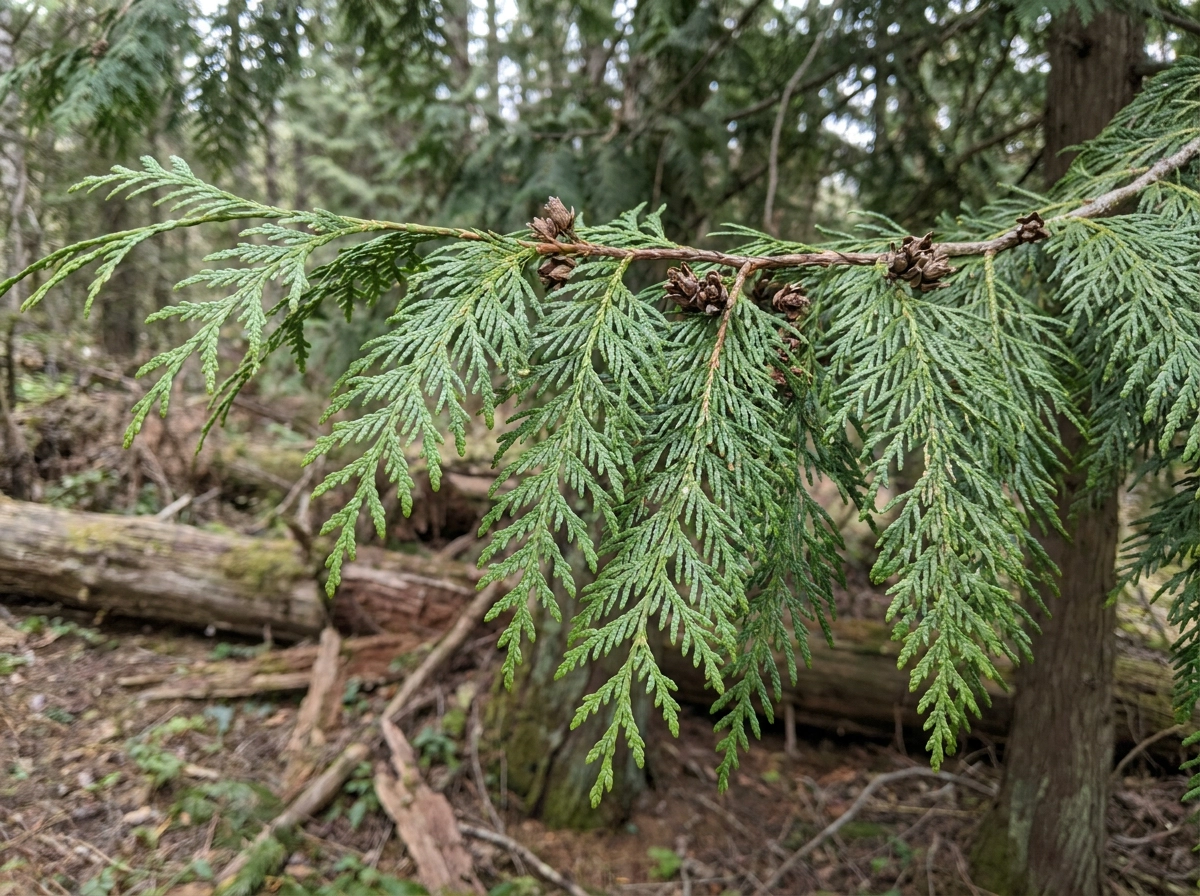
Cedar is the third tree in that mixed bed, usually inheriting the fir routine by default. That assumption starts the three-species problem.
Cedar separates on sight, its foliage looks and feels different from fir or spruce twigs, though a field guide or arborist visit will confirm the ID.
WSU Extension places cedar in the same mixed stand as fir and maple, with maple favouring the moister end of the lot. On a Kitsap lot, cedar sits nearer the maple end than the fir end.
What this article does not claim: cedar failure modes, its response to a specific cut, and its exact water needs are not established by our sources. Cedar care belongs to on-site evaluation, not a copied formula.
Full-size forest trees of this scale often outgrow what the original planting plan assumed.
The Three Species Side by Side
With cedar flagged as its own case, the side-by-side view fits in one table.
| Species | Failure mode | Response to the same cut | Soil and water |
|---|---|---|---|
| Douglas fir | Root disease, with laminated root rot documented in this species (WSU Hortsense) | Most conifers won’t push regrowth from older bare wood, a hard cut tends to leave a permanent gap | Drier, better-drained position on the lot |
| Bigleaf maple | Above-ground limb and stem failure | Vigorous stump sprouting after harvest or fire, per WSU Extension | Deep, loamy, moist soils on toe-slopes and streambanks |
| Western redcedar | Not established by the sources behind this article | Not established by those sources | Not established; that gap goes to an arborist, not a guess |
Treat it as a triage tool, not a verdict. The tree in the wet corner, the tree over the driveway, and the tall conifer on the dry ridge are already three different maintenance priorities.
When to Stop DIY and Book a Tree Risk Assessment
A tree risk assessment evaluates how likely a tree or limb is to fail and what happens if it does. The ISA Tree Risk Assessment standard is the authoritative reference: a defined practice, not a synonym for getting a quote.
Triggers differ by species. For a Douglas fir, unexplained decline, a new lean, or laminated root rot nearby is a root zone question pruning cannot answer. For a bigleaf maple, look above ground: a large limb over a structure or driveway, a split or included union, storm damage, or a trunk wound or hollow. For western redcedar, uncertainty is the trigger: if nobody can say how that tree fails on your site, that gap is why to look before wind season. Pre-storm evaluations give you options; post-storm work is emergency work.
Lefler Tree Service, family-owned and serving Kitsap County since 1988, brings 35+ years of experience to trimming, pruning, and safe removal. An on-site visit sets your lot’s species-level routine.
Care Sequenced by Species, Not by Yard
The routine you build now has to be sequenced per tree, not per yard. Same watering day, same mulch depth, same cut, three different results.
Read position first: the wet corner belongs to maple and cedar, the dry ridge to fir. Then split water, mulch, and pruning three ways.
Carry three rules into the yard: keep mulch off the fir trunk, expect a maple to sprout back after a hard cut, and treat cedar as its own case, not a near-fir.
Match every cut to a reason: health, safety, or another specific goal.
Confirm the species before the next cut. If “spruce tree” is what you call the conifer in the corner, settle that identification first.
Then book a tree risk assessment ahead of Kitsap’s windy season for anything overhanging a structure, and let Lefler Tree Service, serving Kitsap County since 1988, set the species-level plan for your lot.
Conclusion
Each species in your yard has its own failure pattern and its own response to a cut. Sequence care by tree, not by lot, and the right routine follows. Lefler Tree Service is available to assess your lot, confirm species identification, and set a plan that fits what’s actually growing there.