You call up a tree service, describe the big maple shading your backyard, and say the words most homeowners say: “It just needs a little trim.” Seems simple enough, right? Here’s the thing, though. When it comes to mature trees, “a trim” can mean very different things depending on who is holding the chainsaw and what technique they actually use.
The debate around tree pruning vs trimming is more nuanced than most people realize, and choosing the wrong approach on a Kitsap tree can cause lasting damage that no amount of time will fully reverse. Two of the most commonly confused services are crown thinning and crown reduction. They sound similar, but they serve completely different purposes and involve different cuts in different locations on your tree.
In this post, you will learn exactly what sets these two techniques apart, why picking the wrong one can stress or even disfigure a healthy tree, and how to walk into a conversation with your arborist feeling confident and informed. By the end, you will know precisely what to ask before any pruning work begins.
Why ‘Just a Trim’ Is Not a Complete Answer
Most homeowners call a tree service with a simple description: the tree feels too big, too dense, or too close to the house. That vague ask gets translated into “just give it a trim”, which sounds reasonable until you realize “trimming” can mean fundamentally different procedures that produce completely different results.
The distinction between crown thinning and crown reduction is where that gap matters most, and a later section maps it out in full.
Pick the wrong one on a mature Kitsap tree and the consequences are lasting. A 60-year-old big-leaf maple or a towering Douglas fir that gets the wrong prescription can suffer permanent structural disfigurement or long-term stress that no future pruning can fully correct.
Kitsap County’s conditions raise the stakes further. Wet winters, heavy wind loads, and Pacific Northwest species have specific needs that don’t translate from other regions. Kitsap’s notoriously wet winters mean what’s appropriate for a drought-stressed California oak is not the right call for a tree managing heavy seasonal moisture and wind loads.
Understanding the tree care services Kitsap County homeowners actually need starts with knowing which service you’re asking for. This guide gives you the language to have that specific conversation before any cuts are made.
What Crown Thinning Actually Does
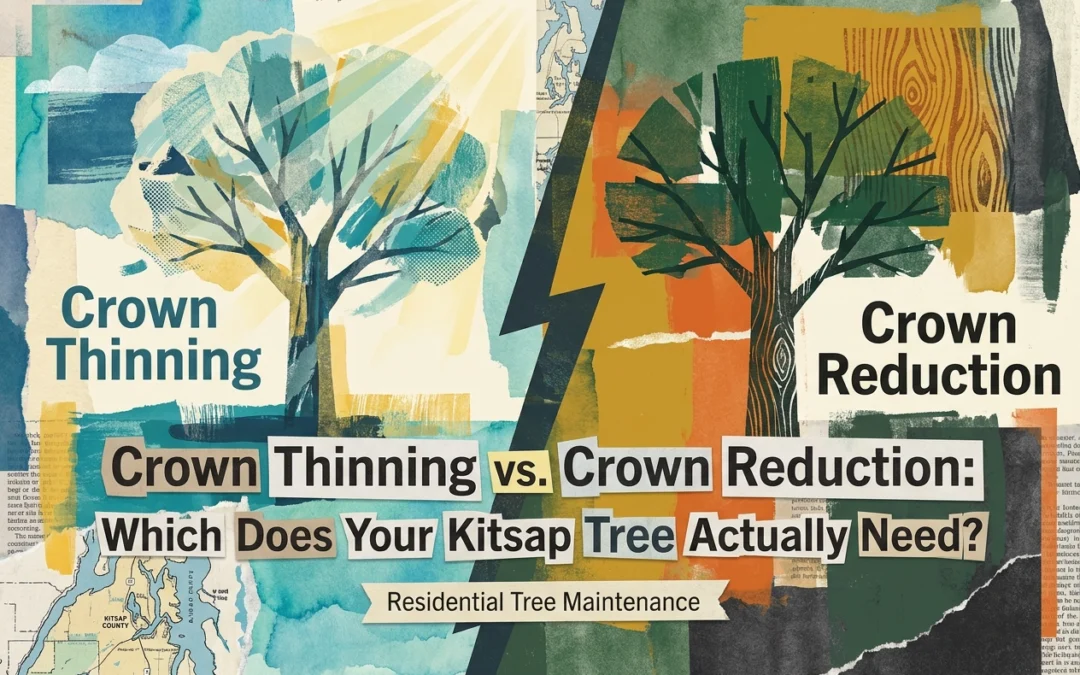
Crown thinning is the selective removal of live branches to reduce canopy density, without changing the tree’s overall size or silhouette. Stand across the street after a proper thinning and the tree should look nearly identical to before: same height, same spread, just noticeably lighter and more open inside.
That openness is the point. Better light penetration reaches the lawn, garden beds, or structures below, and improved airflow through the crown supports the tree’s long-term health by reducing fungal pressure and moisture buildup.
Thinning also addresses mechanical stress. Branches carrying structural defects, such as cracks, cavities, or codominant stems (two stems competing to be the main leader), are more vulnerable to gravity, wind, ice, and snow loads. Selectively removing the right branches reduces that load before it becomes a failure risk, which matters considerably during Kitsap’s wet, heavy winters.
Where the cuts go matters as much as how many are made. Proper thinning targets the end portions of limbs, typically removing branches in the 1 to 4 inch diameter range on large trees. Cuts made primarily to the interior of the crown are a red flag, not thinning done correctly. This is a common mistake made by under-trained contractors, and it can leave a tree structurally weaker, not stronger.
For ornamental trees like Japanese maple, which are common in Kitsap residential yards, the technique requires proportionally smaller cuts, typically 0.25 to 0.5 inches, and significantly more precision. Understanding this kind of species-specific detail is part of what professional tree arborist services include and when to call a certified expert rather than a general contractor.
What Crown Reduction Actually Does
Crown reduction works differently from the ground up. Where thinning opens a canopy while leaving its shape intact, reduction physically shrinks the tree, bringing down both height and spread. These are different goals requiring different cuts.
Reduction is the right tool when a tree has outgrown its space. If branches are pushing toward your roofline, creeping over a fence, or crowding a utility line, the problem isn’t density, it’s size. Thinning won’t solve that. Reduction will.
The work involves cutting each branch back to a lateral large enough to take over as the new lead. This is called a reduction cut. It allows the tree to compartmentalize the wound and heal around it. Stub cuts or flush cuts skip this step and invite decay.
The tree will look smaller afterward. That’s the point. It also means reduction is the wrong choice when the real goal is light or airflow, using it in that scenario permanently alters a tree’s form when a lighter approach would have done the job. For a deeper look at how pruning decisions get made, Tree Pruning 101: What Kitsap County Homeowners Need to Know is a useful starting point.
In Kitsap County, reduction is a common recommendation for big-leaf maple. That species can reach considerable size in Pacific Northwest conditions, and trees planted too close to homes or outbuildings can become a problem faster than homeowners expect.
Reduction also comes into the picture after storm damage. When a tree’s structure has been compromised, reducing canopy load is sometimes part of the recovery plan, and that work calls for professional tree trimming and pruning services with the diagnostic experience to assess what the tree actually needs.
Crown Thinning vs. Crown Reduction: A Direct Comparison
Now that you understand what each technique does on its own, here’s how they stack up directly.
| Crown Thinning | Crown Reduction | |
|---|---|---|
| Goal | Improve light, airflow, reduce limb stress | Decrease canopy size and structural load |
| Visual result | Silhouette stays intact | Height and spread visibly smaller |
| Where cuts are made | Branch ends; selective interior removal | Main branches cut back to strong laterals |
| Best for | Dense canopy blocking light; early structural defects; improving wind resistance without resizing | Tree has outgrown its space; branches encroaching on a structure or utility line; excess canopy weight flagged after storm assessment |
What they have in common: improper cuts in either method cause lasting damage. Neither is a DIY task on a mature tree. For a broader look at how these decisions fit into routine care, the Tree Trimming guide for Kitsap County homeowners is a useful starting point before you call a pro.
Regardless of how the work gets described in a quote, what matters is whether the goal matches your tree’s actual problem. That alignment is what separates a good outcome from a costly mistake.
The Pruning Mistake That Looks Like Thinning But Isn’t
There’s a third outcome beyond “thinning done right” and “reduction done right”: thinning done wrong. It’s called lions-tailing, and it’s more common than most homeowners realize.
Instead of removing branches from the ends of limbs, a contractor strips out most interior growth and leaves the tips loaded with foliage. The tree looks lighter. It isn’t. ANSI A300 pruning standards explicitly classify lions-tailing as an unacceptable practice because it does the opposite of proper thinning.
The result is long, whippy limbs heavy at the tips and bare everywhere else. The center of gravity shifts outward and upward, where wind speeds are greatest. Previously shaded bark becomes exposed and sunburned. These are failure points, not cosmetic problems.
Some contractors have financial incentives that favor volume over precision, a dynamic worth keeping in mind when evaluating bids. Interior branches generate volume fast with minimal precise cutting, creating pressure to strip the inside rather than make the careful end-of-limb cuts proper thinning requires.
Homeowners often don’t notice anything is wrong for a year or two. Then the tree starts throwing dense water sprouts along the trunk, or a branch fails in a winter storm. If your tree is showing those signs, read about hazardous tree removal warning signs for Kitsap County homeowners before the next storm season.
Before work begins, ask specifically where cuts will be made and whether the crew follows ANSI A300 standards. Lefler Tree Service, with over 35 years of experience in Kitsap County, always performs structural pruning before aesthetic shaping, the sequence that protects long-term health rather than just immediate appearance.
Kitsap Trees, Pacific Northwest Conditions, and When to Prune
Knowing what not to do is half the battle. The other half is understanding how the right technique changes depending on which tree is actually standing in your yard.
Big-leaf maple (Acer macrophyllum) spreads aggressively and often outgrows its space, making crown reduction the usual call. For a mature, well-placed specimen, thinning preserves what makes it beautiful. Understanding how tall trees can grow in residential yards helps set realistic expectations before any work begins.
Douglas fir and Western red cedar have distinct growth structures; consult a certified arborist before scheduling any thinning on these species. Topping is widely condemned by arboricultural standards and should never be accepted as an alternative to proper reduction.
Japanese maple needs a light touch. Thinning cuts in the 0.25 to 0.5 inch range maintain the layered, sculptural form that makes these trees worth having. Crown reduction risks destroying that character permanently.
Timing matters here more than most people realize. Late winter to early spring, before bud break, is the preferred pruning window in Kitsap’s climate. Energy reserves are intact, and wound closure kicks in quickly once growth resumes.
Wet winters mean heavy snow and ice loads. A structural assessment in early fall, with targeted thinning on branches showing known defects, can reduce wind sail and ice accumulation before storm season arrives.
There is no universal prescription. A qualified arborist who knows Pacific Northwest species will evaluate your specific tree, its placement, and its structure before recommending anything.
A Simple Decision Guide: Which Service Does Your Tree Need?
Once you know how your specific tree behaves in Kitsap’s climate, the next step is matching that knowledge to the right service.
You likely need crown thinning if:
- The canopy is blocking too much light in your yard or garden
- The tree is well-placed but feels heavy and dense
- You can see branches with early cracks or codominant stems under stress
- You want the tree to flex better in high winds without changing its shape
You likely need crown reduction if:
- The tree is physically too large for its space
- Branches are reaching toward your home, fence, or a utility line
- Storm damage has left the overall canopy load unmanageable
- The tree has simply outgrown the landscape since the house was built
Get a professional assessment first if:
- The tree has visible decay, large dead limbs, or recent storm damage
- You are unsure whether the core issue is density, size, or structural integrity
The right starting point is always an on-site visit. A phone description cannot substitute for eyes on the tree. If you are in the Bremerton area, this guide to tree trimming in Bremerton explains what a proper evaluation should include and what to expect from professional tree trimming and pruning services in Kitsap County.
Questions to Ask Before Any Pruning Work Begins
Once you know which service your tree needs, the next step is vetting the person doing the work. These five questions will help you hire with confidence.
“Are you recommending thinning or reduction, and why?” Any qualified arborist should answer this in plain terms before touching the tree. If they can’t explain the goal clearly, that’s a problem.
“Where will the cuts be made?” Thinning targets the ends of limbs; reduction cuts back to a strong lateral branch. If the answer centers on clearing out the interior, that’s a red flag for lions-tailing.
“Do you follow ANSI A300 pruning standards?” This is the U.S. industry benchmark for professional tree pruning and trimming services. Any reputable contractor should know it by name and work within it.
“How much of the canopy are you removing?” Thinning should generally stay within 15 percent of the live canopy in a single visit. If a contractor proposes significantly more, ask for specific reasoning before agreeing.
“What should I expect after the work is done?” A good arborist will walk you through healing timelines, possible sprouting, and when a follow-up visit makes sense. If they plan to finish and leave without any guidance, factor that into your decision.
For more on evaluating contractors, this guide to choosing the right tree trimming company covers what to look for before you hire.
The Right Cut Makes All the Difference
Once you know the right questions to ask, the rest comes down to having the right team answer them.
As covered above, the wrong technique on a mature tree can cause permanent structural damage no future pruning can undo.
In Kitsap County, the stakes are real. Big-leaf maples, Douglas firs, and ornamental trees are all managing heavy rainfall, ice loads, and strong seasonal winds. A tree pruned correctly handles those conditions far better than one that was “trimmed” without a clear goal in mind.
Lefler Tree Service has been helping Kitsap homeowners sort through exactly this kind of decision since 1988. Over 35 years of working with Pacific Northwest trees means the recommendation you get is based on what your specific tree actually needs, not a default service applied to every yard on the route.
If you’re still unsure whether your tree needs thinning, reduction, or something else entirely, a professional site assessment is the right first step. Contact Lefler Tree Service to schedule a consultation and get a clear, tree-specific recommendation before any cuts are made.
Conclusion
Three takeaways to carry forward: terminology matters, the Pacific Northwest environment shapes every pruning decision, and a qualified arborist should always assess before any cuts are made.
Your trees are a long-term investment in your property and your landscape. Protecting that investment starts with asking better questions and working with a team that gives honest, tree-specific answers.
Ready to know exactly what your tree needs? Contact Lefler Tree Service today and get a professional assessment that leads to the right cut, made the right way, the first time.