Ninety feet of fir. Two Bremerton houses. A drop zone about the width of a driveway.
That’s the setup, and it’s why this job was never going to be a straight fell. Tight lots shrink your options and push the real work into planning, long before anyone pulls a starter cord. What follows is a first-person account of how we worked through it.
I’m not here to sell a saw, a rope brand, or an app. Nothing off a shelf holds a limb. A planned system, inspected gear, and trained operators do.
Along the way I’ll cover why this lot ruled out a straight drop, how we chose between rigging and crane tree removal, what made one anchor tree trustworthy under load, how rope and hardware get picked by category rather than label, and why cut sequence beats saw choice. Then load limits, the spotter’s vocabulary, and the honest answer to what actually kept this removal off the roof. Lefler Tree Service is family-owned and has served Kitsap County since 1988, with more than 35 years in the industry. Here’s how the plan, not the gear, held the tree.
The Lot That Ruled Out a Straight Drop
The fir stood on a narrow Kitsap lot, one house close on each side, a fence line behind, a driveway in front, and no stretch of lawn wide enough to catch anything.
The instinct was the simplest one: drop it in one piece and walk away. That method never made the list. “It’ll fit between the houses” is the first wrong thought most people have. A falling tree sweeps an arc, and the gap between two houses is not vertical. The top would have traveled well past the fence before the butt left the stump.
So before any gear came off the truck, we measured: the tree’s height against each roofline, the distance to both structures, the direction and amount of lean, the crown’s weight bias, and where the ground would actually let a piece land. How tall trees behave in residential yards often follows the same constraints.
The lesson for anyone studying tree felling methods: the lot rules out options before preference gets a vote. Choosing how to bring a tree down starts with the site, not the saw.
Rigged, Craned, or Straight Felled: How the Method Got Decided
Once the lot ruled out a straight drop, three broad methods were left, and naming them plainly helps.
Straight felling sends the whole tree over at once. Sectional removal with rigging brings it down in pieces on ropes. Crane-assisted removal uses a machine to lift pieces clear of the site.
Straight felling was eliminated first: there was nowhere on this lot for the tree to fall. That ended it.
To be clear, no crane was on site for this job. But the crane question is a real one on tight lots, so it’s worth walking through generally. For crane tree removal to win, three things have to be true: room for the machine to set up, a spot to stage the outriggers, and access to lift pieces clear of the site rather than just off the roof. Not every residential lot offers all three at once.
The trade-off is straightforward. A crane removes the need to lower loads by rope, but it adds setup, access, and mobilization demands a tight lot may not allow. That makes it a site-driven answer, not a superior one.
The decision rule we use is simple: the method follows access and how finely the load has to be controlled, not what the crew likes to run. If you’re planning tree removal in Kitsap County, that order matters more than any equipment list.
Here, access and control both pointed to rigging. Everything after this was about making that plan hold.
Choosing the Anchor: What Makes a Tree Trustworthy Under Load
This is how we approach it, there is no single industry rule that covers every case.
Once the method was settled, the anchor became the next decision. An anchor point is simply whatever the rigging line ties back to, the tree, stump, or ground anchor that holds a cut piece while it is lowered or held back.
On this job, the anchor had to earn it. We wanted a sound trunk with no visible decay or hollow, an intact root plate, enough diameter for the working load, and a position and angle that sent the load path away from both houses.
The disqualifiers are just as important. On our jobs, we automatically remove a candidate from consideration if we see vertical cracks, conks or fungal growth, cavities, dead tops, a buried root flare, saturated or shallow soil, or any tree we cannot inspect thoroughly. A tree inspection arborist works the same negative list from the ground.
Splitting the load between two anchors is common on a tight lot. It reduces the pull on any single tree, dampens the shock when the line comes tight, and positions the anchor behind the climber rather than in the line of fire.
Anchor choice is a ground-level judgment call, made with a stated backup, and re-checked as the job progressed, not set once and forgotten.
Rope and Hardware: Categories That Matter, Brands That Don’t
What follows is our working approach, not a cited standard, the industry is still developing a dedicated federal rule.
With the anchor settled and re-checked, the gear becomes the next layer of the system. No single item carries a limb; they work together.
The rigging line: We match it to the working load and the lowering method, and we track its service history. We keep it clean and dry, and retire it on condition rather than age alone.
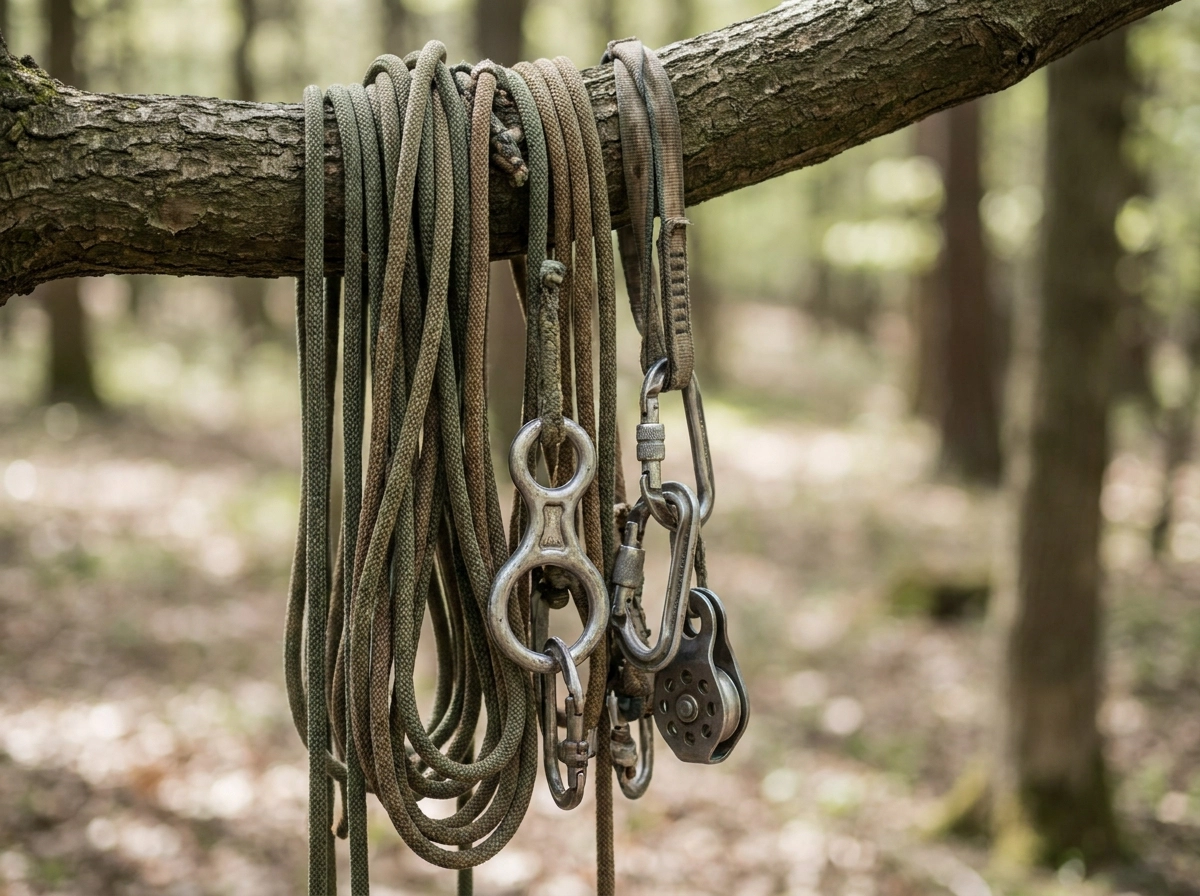
The friction device at the base of the tree is what turns a falling piece into a controlled descent. We use it to absorb most of the energy and to control how much the ground person actually feels on the line.
Blocks, slings, and connectors: We use rated hardware only, with spliced or properly terminated ends and rated connectors. We never improvise anchors around trailers, bumpers, fence posts, or an uninspected second tree.
Inspection happens before every use. We look for glazing, cuts, abrasion, broken strands, and stiffness in rope; deformation, cracks, or worn pins in hardware. Anything questionable comes out of service that day.
That routine applies on every job, from a tight takedown to everyday tree trimming.
Our philosophy is simple: nothing bought off a shelf holds a limb. A shelf item only works inside a planned system run by trained operators.
The Cut Sequence: Why Order Beats the Saw
With the gear inspected, the order was already settled. We wrote the sequence on the ground before anyone climbed: which limb came off first, which piece opened working space, which piece was the last thing still holding the top, and how the crown would come apart.
Balance point is where tree limb removal goes wrong. Cut a limb at the wrong spot and it rotates toward the structure instead of hanging clean on the line, turning a light piece into a load the ground person has to fight. In our practice, we use the notch to set direction, the hinge to steer the piece as it commits, and the back cut to release it while the rigging line carries the weight.
The top came down in sections rather than as one piece. Less load at the anchor, a piece that stayed inside the control envelope, and a spotter who could see the whole maneuver instead of guessing at it.
Every cut was released on a signal from the ground, never on a guess. That is the practical difference between a sequence and an improvisation. The same judgment, on a tree you are keeping, is what separates crown thinning from crown reduction.
Load Limits: The Math That Makes a Limb Safe to Cut
The cut sequence only holds if each piece is sized to what the system can take. Load limit means the worst-case demand on the rope, anchor, and hardware, not the static weight of a limb hanging still.
That worst moment is rarely the quiet one. A limb that swings, drops, or comes tight on the line can spike well beyond its static weight in an instant, and that spike is what the gear has to survive.
Piece size got estimated roughly, from what we could estimate of volume and wood density, then rounded down the moment anyone hesitated. A smaller piece costs a few minutes of time. A too-large piece costs control.
The friction device at the base of the tree is doing the real math. Lowering slowly spreads the energy of the descent across more time, which flattens the peak load the anchor and line ever see.
The crew watched for warning signs the whole way: an anchor flexing, a line loading harder than expected, a piece not behaving as planned. Each one triggered the same response. Stop, re-plan, cut smaller pieces, redirect the line.
Every limb is its own load case. Treating tree limb removal as a series of small engineering problems instead of one big guess is what keeps a removal predictable. When a tree is already past that point, hazardous tree removal in Kitsap County covers what to look for and when to call.
The Spotter and the Vocabulary That Keeps Everyone Safe
Load math only works if someone is watching the load. That job belongs to the spotter, and it’s the spotter’s only job. The climber cannot see the anchor, the line path, the ground person, and both rooflines at once. Someone on the ground holds that whole picture and calls the cut.
Our crew uses a fixed set of calls, here is what each means on our jobs: Tension means the line is loaded and taking weight. Slack means it’s free. Hold means stop where you are. All clear means the drop zone is empty and the cut can commit. Coming down means the piece is moving. Stopped means everything freezes until the spotter says otherwise. Each of those means exactly one thing to everyone on site.
Backups matter once the saw is running. Radios stay on one clear channel, and hand signals are agreed before the first climb, not invented mid-cut.
Nobody stands under the load path. The drop zone comes from the rigging plan, not from where a piece was supposed to land.
In our experience on tight lots, the failure mode is usually a timing problem or a misread signal. That’s why this crew treats communication as safety equipment, not a courtesy.
What Actually Kept This Removal Off the Roof
That spotter was the fifth of five controls doing the real work here: the rigging plan, the anchor choice, the cut sequence, load awareness, and one shared vocabulary. All five were settled before the first pull of the starter cord. Our operating experience is blunt about it. No saw, gadget, or app holds a limb. The plan and the people running it do.
On the next tight lot, we run the same order: measure and plan, pick and inspect the anchor, size each piece to the load, cut in sequence, and keep one voice on the radio.
If you’re hiring, ask questions that get at the approach rather than the equipment. How will you rig on a site like this? How did you choose and check the anchor? Who spots, and how do you communicate? How are the structures protected, and how is gear inspected before it goes up?
A tree between two houses is not a homeowner project. The useful homeowner role is verifying the approach, not attempting the rigging. Our step-by-step emergency tree removal process shows how a planned sequence plays out when a tree can’t simply be dropped.
The Plan Holds the Tree, Not the Gear
Nothing we carried up that fir mattered as much as what we settled on the ground first. The same order held throughout: method driven by access, anchor chosen and inspected, pieces sized to the load, and one voice watching the drop zone.
For removal work that has to be rigged rather than dropped, Lefler Tree Service has handled safe removal and tree care across Kitsap County since 1988, and the same planning sequence applies whether the job takes an afternoon or a full day. Weighing crews for a lot like yours? Our guide to tree trimming in Poulsbo, WA covers what to ask before hiring.
Conclusion
When the site rules out a straight drop, the plan, anchor, sequence, load sizing, and a shared vocabulary, is what actually keeps both roofs safe.
If your tree cannot simply be dropped, start by talking through the site with Lefler Tree Service. A good plan today protects your home, your landscape, and your peace of mind tomorrow.