
Most homeowners watch tree pruning from the kitchen window, see some branches come down, and hope for the best. That is a tough way to judge quality. So let’s slow it down. This is the story of one Kitsap pruning visit, two maples, and a single afternoon. Instead of another list of tips, you get a first-person walkthrough of the job from the ground up. We will start with the 15-minute walk-around before the first cut, then look at three cuts that mattered: one branch that was going to fail, one that restored structure, and one narrow attachment most people never notice from below. You will also see which limbs the crew deliberately left alone, how cleanup and debris handoff worked, and what the before and after tree trimming actually showed. Along the way, we will point out what a rushed crew skips and how to judge local tree trimming services before you hire. By the end, you will have a practical standard you can check, not just a pretty yard.
Two Maples, One Afternoon: The Job and What the Owner Saw
Here is how a typical Kitsap afternoon looks in Lefler’s notes: two maples on a residential lot, pruned in a single visit. The owner wasn’t shopping for a removal bid. They wanted tree trimming and pruning services. A common combination of concerns: a limb angling toward the roof, shade thinning on one side, canopy untouched for about a decade.
Where the notes didn’t record a detail, it’s left out here rather than guessed.
Here’s the point of the walkthrough: from the lawn, both trees looked fine. Every difference that decided the afternoon, the attachment angles, the deadwood overhead, the crossing limbs, sometimes old flush cuts from a previous crew, was only visible from a ladder or a climbed position. That’s the gap between what you can see and what you’re paying for.
What follows is a timed account, from the first walk-around to the loaded chip truck, instead of another list of pruning tips you can’t apply from the ground. If you’ve ever wondered whether you need crown thinning or crown reduction, this is the visit where that question gets answered.
The Walk-Around: 15 Minutes Before the First Cut
On arrival, the crew stages truck and chipper clear of the service drop, marks a drop zone, and sets fixed camera positions for before-and-after comparison.
Then the slow part. For each maple, they check deadwood, crossing and rubbing limbs, and narrow angles of attachment, where bark pinches between two stems. They note clearance over the roof and service drop, inspect the root plate and soil, and look for old flush cuts from a previous crew. A tree health assessment often starts here.
The walk-around ends with a written scope naming which limbs come off and which stay. As the Tree Care Industry Association puts it, ANSI A300 standards are guides for developing written specifications, not specifications themselves. Interpreting that scope takes species-specific judgment: how this maple grows in this soil and light, how much live crown it can lose, and how much shade the homeowner wants.
Walk the tree with the crew, agree out loud on the three or four decisions that matter, and keep a copy of what was agreed.
Cut One: The Branch That Was Going to Fail
The scope agreed on, we started on the maple nearest the house. The first limb off was the one that had concerned us on the walk-around: heavy, attached high on the trunk, hanging right over the driveway. Reducing risk drove it, one of the recognized purposes of pruning.
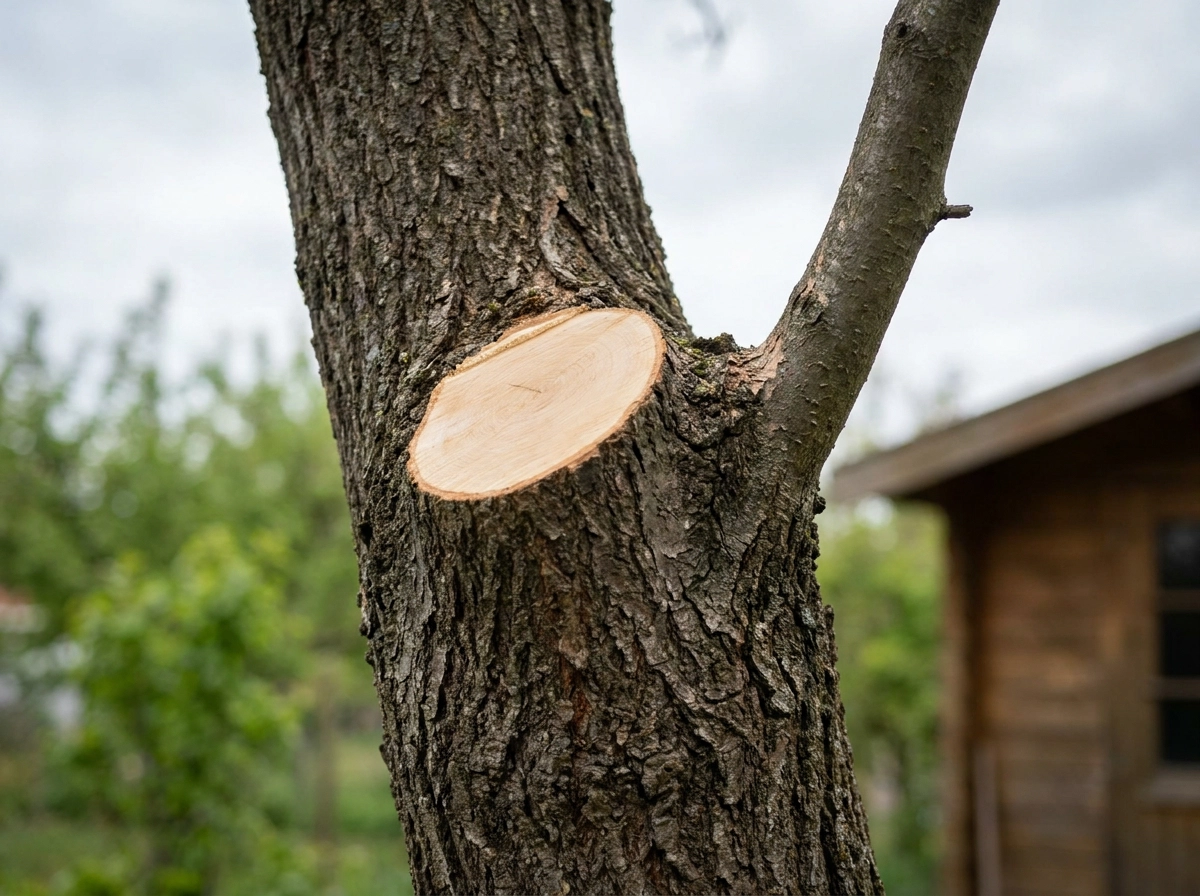
A branch collar is the swollen ring of tissue where a limb meets the trunk. It’s where the tree seals a wound, so the saw stops outside it. Cut flush and you remove that tissue.
On a heavy limb, the standard approach uses three cuts so bark doesn’t tear down the trunk: an undercut, then a top cut a few inches out, then the final cut at the collar. The first two relieve the weight.
From the lawn that limb looked fine. From a ladder, the crew spotted a crack at the attachment point, a typical finding on limbs under this kind of load.
A rushed crew does it differently: one pole-saw cut from the ground, a torn collar, a stub left to die back, and a limb dropped without checking what it lands on.
That judgment is what tree arborist services cover, and it’s a fair thing to ask about before you hire.
Cut Two: Restoring Structure Before It Was Lost
Cut One removed the risk. On the second maple, two codominant stems had grown apart, pushing weight out over the driveway. The crew made a reduction cut, cutting the longer stem back to a lateral strong enough to take over, aimed into open space and positioned to fill the silhouette rather than leave a hole. The purpose was maintaining health and structure. In homeowner terms: less leverage pulling on the attachment, less wood to catch a gust, less to fail next storm.
Fine pruning typically removes no more than 15 percent of live canopy for light and air penetration, a common benchmark the crew keeps in mind. Removing too much live crown at once stresses the tree’s recovery. For a fuller picture of the services that include this kind of work, see our Tree Care Services Every Kitsap County Homeowner Should Know.
Cut Three: The Narrow Attachment Nobody Sees From the Ground
The third cut came from a different tree, and it was the one nobody on the lawn could have flagged. Two stems had grown so close they pinched bark in the crotch, a narrow angle of attachment. Both stems carried full, healthy leaves. Both looked solid at eye level, and the defect only showed when we looked straight up into the fork. The crew’s assessment was that the narrow angle made it a failure risk in heavy weather. Codominant stems like this are a common condition of concern on landscape trees.
We took the smaller stem, cut outside the branch collar, and left no stub long enough to die back and open decay into the trunk. The reason was twofold: reduce the chance of failure, and improve structure. The cleaner silhouette the owner noticed afterward was a byproduct, not the goal.
A second narrow fork stays for now, flagged for monitoring. Since January 1, 2024, the consolidated ANSI A300 standard places more of that ongoing maintenance and monitoring on the tree owner, which makes knowing what to watch for worth your time.
The Limbs We Deliberately Left Alone
Every limb that stayed on those maples stayed for a reason. Nothing came off without tying back to one of the recognized purposes of pruning: reducing risk, improving health and structure, improving appearance, or meeting a stated need.
Low limbs stayed for shade and screening. Stripping them for a tidier trunk line would have reduced the shade those branches provide and removed the reason the homeowner planted the tree.
Interior live branches stayed because they hold the leaves that feed the tree. Stripping interior live branches can trigger fast, weakly attached regrowth along the trunk, a common pattern after over-pruning.
No heading cuts or topping anywhere in either canopy. That choice prevents the crown of long, thin, weakly attached shoots that fails in wind in subsequent years.
Higher up, deadwood stays for now, and that narrow fork is flagged for a later visit. The 2024 revision puts more of that maintenance and monitoring on the tree owner, so the flag is a shared follow-up. Our tree pruning guide explains what those later visits involve.
Cleanup, Debris Handoff, and the Before and After
When the last cut was done, cleanup started before anyone packed up. Standard cleanup includes raking, blowing the driveway and walkways, and clearing gutters.
Debris goes through the chipper on site; chips leave with the truck, and anything worth burning can be cut and stacked for the homeowner. For a closer look at debris logistics, see our step-by-step guide to Kitsap County tree removal.
For before-and-after comparison, shoot from four fixed angles at the same time of day. Side by side, the pairs show a lighter crown, daylight moving through it, no stubs, no torn bark, no brush pile at the curb.
Here is the honest part: a good prune looks like less work than it was. Check the small stuff on any job: clear gutters, a clean lawn, collars cut cleanly with no torn bark.
What a Rushed Crew Skips
A rushed visit hides in what’s missing.
The clearest sign is a cut with no purpose behind it. Limbs come off because the saw could reach them, not because the tree needed them gone, and you find out later through stubs, flush cuts, and a crown thinned past the point of health.
No written scope is a red flag.
Topping and heavy heading cuts are the flashiest shortcut. The tree pushes fast regrowth that looks great next spring, then drops weakly attached shoots in a windstorm later.
Finally, torn bark, cut stubs, an unraked lawn, and a brush pile at the curb. You pay a second time to haul it away.
This is why the standard matters: pruning has recognized purposes. A cut nobody on the crew can justify is a cut the tree pays for. It’s the single easiest thing to ask about before you hire, and it matters just as much when trimming trees in Kitsap conservation areas puts the decision in your hands.
How to Judge Local Tree Trimming Services Before You Hire
Before the first saw starts, request a written scope: which limbs come off, which stay, what each cut accomplishes, and what the tree should look like a month and a year later. The current ANSI A300 tree care standards guide those specifications; they do not replace them.
Ask who makes the cuts and how they reach the canopy: climbing, a lift, or from the ground. That answer tells you whether anyone will look into the tree.
Walk the tree with the crew. Point out what you see from the ground, then ask what they see that you cannot. That gap is why you’re hiring someone.
Confirm cleanup, chipping, hauling, gutters, is in the scope before comparing prices.
When you call around for local tree trimming services, compare what each crew says it will leave alone. That separates a pruning plan from a trim job. Lefler Tree Service is one Kitsap option, family owned and operated since 1988 with more than 35 years of experience.
One Afternoon, Two Maples, and a Standard You Can Check
The three cuts each tied to a stated reason; the limbs left standing were the plan.
Ask any crew what it is leaving and why. That question separates a pruning plan from a trim job.
Cleanup is part of pruning, not a favor. Confirm chips, brush, and gutter clearing in writing before you sign.
Before you call, photograph your tree from four fixed spots, note what bothers you, and ask for a written scope. Then compare it with the finished work.
If your maples carry the shade, screens, or views you care about, book a pruning visit with Lefler Tree Service and start with the walk-around.
Conclusion
If your maples matter to your home, book a pruning visit with Lefler Tree Service, family owned and operated since 1988 with more than 35 years of experience, and start with the walk-around.