When a big tree comes down in a Kitsap yard, the chainsaws stop but the work is just beginning. That stump is not the only thing left behind. The soil, sunlight, and wind patterns around your home shift, and the first year after removal often decides whether the space recovers or turns scalded and bare. This follow-up guide walks you through what happens next, including decaying root plates, whether roots keep growing, and when tree root removal makes sense before you replant.
You will also learn how deep a stump grind should really go, what to do with the grindings and the hole, and how to protect newly exposed trunks from winter sunscald. We will cover why south and southwest bark can burn on a cold sunny day, how to pick and time a replacement for Kitsap soil, and what first-year care looks like. If you have just paid for a removal, these steps help protect that investment and give the next tree a better start.
Why Removal Changes a Kitsap Yard More Than You Expect
Most removal articles stop at the invoice. The trunk was never the whole story; your yard is what changes, permanently.
Where a canopy blocked rain and shade, that footage now gets full sun, full rainfall, more wind, and wider soil temperature swings. Shrubs, lawns and retained trunks were shade-acclimated for decades.
Below ground, root turnover, lost rain interception and missing leaf litter change how water moves through the upper soil. Soil moisture patterns shift noticeably in the first season, some yards drain differently, others stay wetter near the old root zone.
The first year decides whether that ground recovers as lawn, bed or new tree, or scalds and stays bare with weeds. That is the money-protection part of the job.
Three decisions follow: roots and the root plate, the stump, and what to plant and when. Still weighing a removal? Lefler Tree Service has served Kitsap County since 1988 and offers trimming, pruning and removal, along with the tree care services every Kitsap County homeowner should know.
What Happens to Roots and Root Plates After the Trunk Is Gone
The root plate is that anchored tangle: thick structural roots plus fine feeder roots, mostly in topsoil, reaching past the canopy edge. With no canopy making carbohydrates, soil fungi and microbes begin breaking the roots down. Decay runs faster in warm, moist, airy soil like most Kitsap beds, but stalls in compacted or soggy spots.
As structural roots rot, voids open underground. That is why lawns dimple, paths crack, and patios drift out of level years later, not weeks later, and why professional tree stump removal involves more than the trunk. Old root tips don’t grow into a new tree. Cut roots near the stump can live on stored reserves briefly, and grafts from neighboring trees can feed stump roots. Expect decay in years, not one season. On species prone to root sprouting, a flush of shoots from the stump or roots in the first year is not unusual. How long that takes is the next question.
Do Roots Keep Growing, and How Long Until a Root Plate Settles?
Short answer: no. Roots left in the ground do not keep growing into a new tree. They decay. Any green you see is stump or root sprouts, not the old root system returning.
Fine feeder roots typically break down before structural roots, though exact timelines vary by species, wood density and soil conditions, no single figure applies to all Kitsap sites. Warmer, moister soils generally speed decay compared to cold dry conditions. Saturated soil also stays soft, so settling and sinkholes show up sooner.
If paving, a path, a shed base or a new tree goes there, assume the void keeps shifting for years and design for it.
Tree Root Removal: When Roots Should Come Out Before You Replant
Most homeowners asking about tree root removal mean the surface roots that stall a mower, lift a walkway, or make a planting bed impossible, not the whole buried root system.
Left in place, those roots decay and sink, can heave turf for a few seasons, and on sucker-prone species keep pushing up shoots.
Grinding the stump is usually the practical alternative to chasing roots across the yard. Ripping large roots out with equipment shears soil structure and disturbs the root zones of nearby trees.
That matters most for trees you’re keeping. Cutting structural roots inside a retained tree’s root plate can destabilize it and opens wound sites to decay, so root removal near a keeper is a job to plan with an arborist, not a weekend project. Safe cutting distances depend on species, trunk size, and soil, so learn what professional tree arborist services cover before you cut.
Tree Stump Removal: How Deep Should a Grind Actually Go?
Before you hire a grinder, answer one question: what will this spot become? Turf, a garden bed, or a new tree each calls for a different depth, so decide first. A grinder chips the stump and nearby surface roots into a hole about the stump’s footprint; the operator sets depth, which is why quotes vary. Deeper grinds remove more wood and cost more. Shallow ones leave material that stays soft and sunken, making mowing or planting a fight for years. Industry practice often quotes 8 to 12 inches, but treat that as a common range, not a standard. A grind does not remove the root plate beyond the footprint. Roots outside keep decaying and can settle or create voids years later. Confirm depth with a local arborist for your site, and see Stump Grinding: Complete the Job Right to finish the work.
What to Do With the Grindings and the Hole
Grindings are a coarse mix of wood chips, bark and soil, not clean topsoil, and far chunkier than new roots need. Fresh chips borrow nitrogen as they break down, so never fill a planting hole with pure grindings.
Spread them as mulch on established beds away from trunks, add them to an active compost pile, or have them hauled off. Left in a tall pile, they smother turf and bury nearby surface roots.
Close the hole by backfilling with native soil or a soil and compost blend in shallow lifts, watering each lift to settle it. Expect ongoing settling, and never mound soil against a nearby trunk.
Planting immediately into a hole full of pure grindings is a common way to lose a new tree in year one. Facing a removal instead? Our guide to tree removal in Bremerton covers it.
Sunscald Risk for Trees That Just Lost Their Shade
That newly opened sky hits more than the ground. UC IPM notes that older trees can be damaged when bark is newly exposed to sun, and that removing shade-providing trees can cause sunburn. Symptoms include dead bark on the south or southwest side of trunks and branches; according to Manitoba Agriculture, symptoms can take months to fully appear.
Young and thin-barked trees are widely cited as most susceptible. A hazardous tree removal, or any pruning that raises and thins a canopy, increases direct sun and reflected heat on trunks shade acclimated for decades.
Why Winter Sun Does the Damage
The reason comes down to how bark temperature moves independently of air temperature in winter. Sunscald does its worst work in winter, not summer. On a sunny, cold day, a trunk’s south side warms far above air temperature and loses cold hardiness. Then a passing cloud or sunset drops that bark below freezing faster than it can reacclimate.
These figures are illustrative. FS197E cites peach cambium at 86°F while the air was 31.5°F, and a 1923 study where plum cambium rose 18°F in three minutes as a cloud passed. Eggert’s 1944 New Hampshire data showed south-to-north cambial gaps of 50 to 55°F in peach and 30 to 35°F in apple.
Damage is greatest in winters with rapid, wide temperature swings. Areas with sunny winter days, cold nights, and rapid cloud cover changes are at higher risk, check with a local arborist about your site’s exposure. The first winter after removal, long after the crew leaves, is the window to watch, whether that spot ends up a fig tree or lawn.
How to Protect a Newly Exposed Trunk
Practitioners whitewash the exposed south or southwest side with diluted interior latex paint or a commercial trunk whitewash, or wrap thin-barked trunks with a guard, slowing the temperature swings that cause damage. Verify products and timing against the full WSU publication or an ISA source before applying anything.
Keep the canopy. Don’t remove more live branches from that tree this season; the remaining foliage shades the trunk and feeds the roots. Mulch out toward the drip line, a few inches off the trunk, to steady soil temperature and moisture.
Avoid heavy fall pruning, late-season nitrogen, and soil disturbance inside the root zone. Check fertilizer and pruning timing against WSU recommendations, and when in doubt, ask a Bremerton arborist who handles safe tree care.
Replanting a Kitsap Yard After Removal
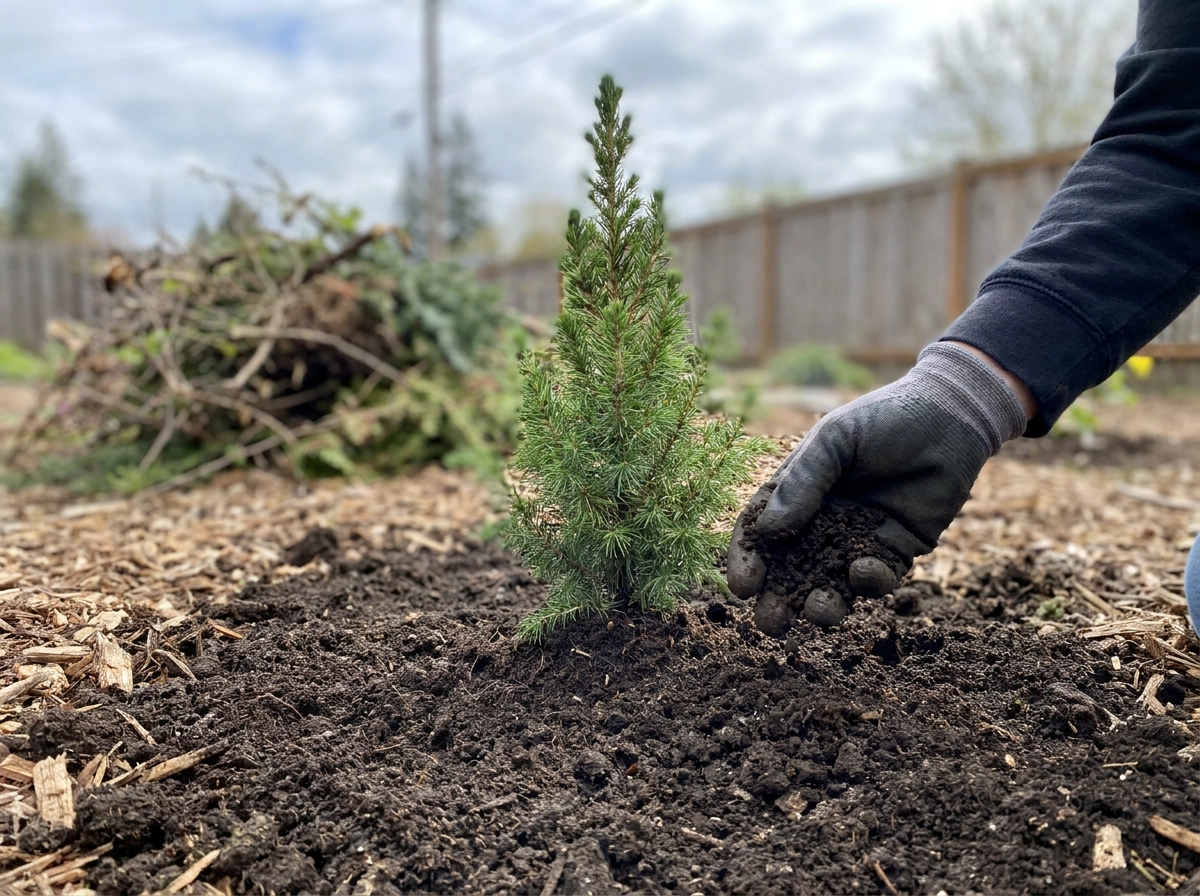
With your retained trunks protected, the next question is what goes back in. Treat replanting as a soil and site decision first, a nursery trip second: light, moisture and soil structure all changed, and the old root plate may still be decaying under the planting spot.
Planting too deep is a widely documented mistake that can doom a landscape tree before it gets started. Get the hole, root flare and depth right before shopping.
Sequence it: settle the stump question and grind depth, let the site settle, pick a species, then plant in the right window. Planting a few feet off the old stump footprint avoids rooting into decaying wood, voids and uneven fill; get exact offset guidance from a cited arborist source.
Before publishing any local soil claim, verify Kitsap soil depth, drainage, compaction and glacial till with WSU Extension or an NRCS survey.
Choosing a Replacement for a Suddenly Sunny Spot
With the site prepped, let the changed light guide your pick. That spot is now full sun, so skip shade-loving understory species that thrived beneath the old canopy.
Match the replacement’s mature size to why the tree came down. Overhead lines, view corridors, foundation or sewer conflicts, and the room a trunk and canopy need in twenty years all rule out certain choices. A tree that outgrows its welcome repeats the problem.
Think function. An evergreen restores year-round screening and shade but blocks winter light. A deciduous tree gives summer shade without darkening your house in January.
Sunscald works both ways. A thin-barked young replacement planted into a fully exposed site faces its own first-year risk, so pick and site with that in mind.
One caution: we cannot hand you a Kitsap species list without a WSU, extension, or nursery source behind every entry. Confirm recommendations locally before you buy.
First-Year Care and What to Watch For
One tree is gone, but the watching has just begun. Here is a simple calendar.
Late winter to early spring: check the south and southwest sides of retained trunks. Sunburn symptoms can take months to appear, so a tree that looks healthy the week of removal may decline later.
Spring: cut stump and root sprouts back while they are small, and expect to repeat it. The stump’s stored energy supports repeated regrowth without canopy photosynthesis to sustain it.
Summer: watch for drought stress in a suddenly sunnier yard.
Fall: look for sunken spots over the old root plate and grind hole. Top dress with soil or compost to grade; never mound soil against a trunk. Recheck paving and patio edges.
For new plantings, keep the root flare at grade, water through at least the first two to three dry seasons, and continue supplemental watering during drought until the tree is established, which can take three to five years. Mulch without burying the trunk. Some transplant shock is normal, not failure.
The First Year Decides Whether the Lot Recovers
The sections above have covered each piece of the puzzle. The trunk leaves with the crew. The removal doesn’t.
That is how you protect what you just paid for. Fixing a scalded, barren first year costs more than the follow-through does.
For pruning, trimming, removal or other tree care in Kitsap County, Lefler Tree Service, family owned and operated since 1988 with more than 35 years of experience, can advise on tree care in Kitsap County.
Questions about local tree rules belong with Kitsap County. This piece gives tree care guidance, not legal or permit advice.
Conclusion
These steps, stump, sun protection, and replanting, are how you protect what you paid for. Before you replant or prune, contact Lefler Tree Service for tree care in Kitsap County. Match species to the new sunlight, keep root flares at grade, and water through at least the first two to three dry seasons, continuing supplemental watering during drought until the tree is established, which can take three to five years. Watch for sprouts, drought stress, and sunken spots, then top dress to grade without mounding soil against trunks. Family owned and operated since 1988 with more than 35 years of experience, Lefler Tree Service can help you protect what you just paid for and start the next canopy right.